



Stamped Concrete Installation & Restoration
Stamped concrete for Charlotte-area homes — honest pattern selection, disciplined color layering, and a sealer schedule tuned for Piedmont freeze-thaw and Mecklenburg summer humidity. Zero deposit, licensed and insured, written spec before a form board goes down.
Get your free quote
We respond in less than 2 hours.
Recent Stamped Concrete Projects
Real customer jobs we've poured. Swipe through and picture yours next.
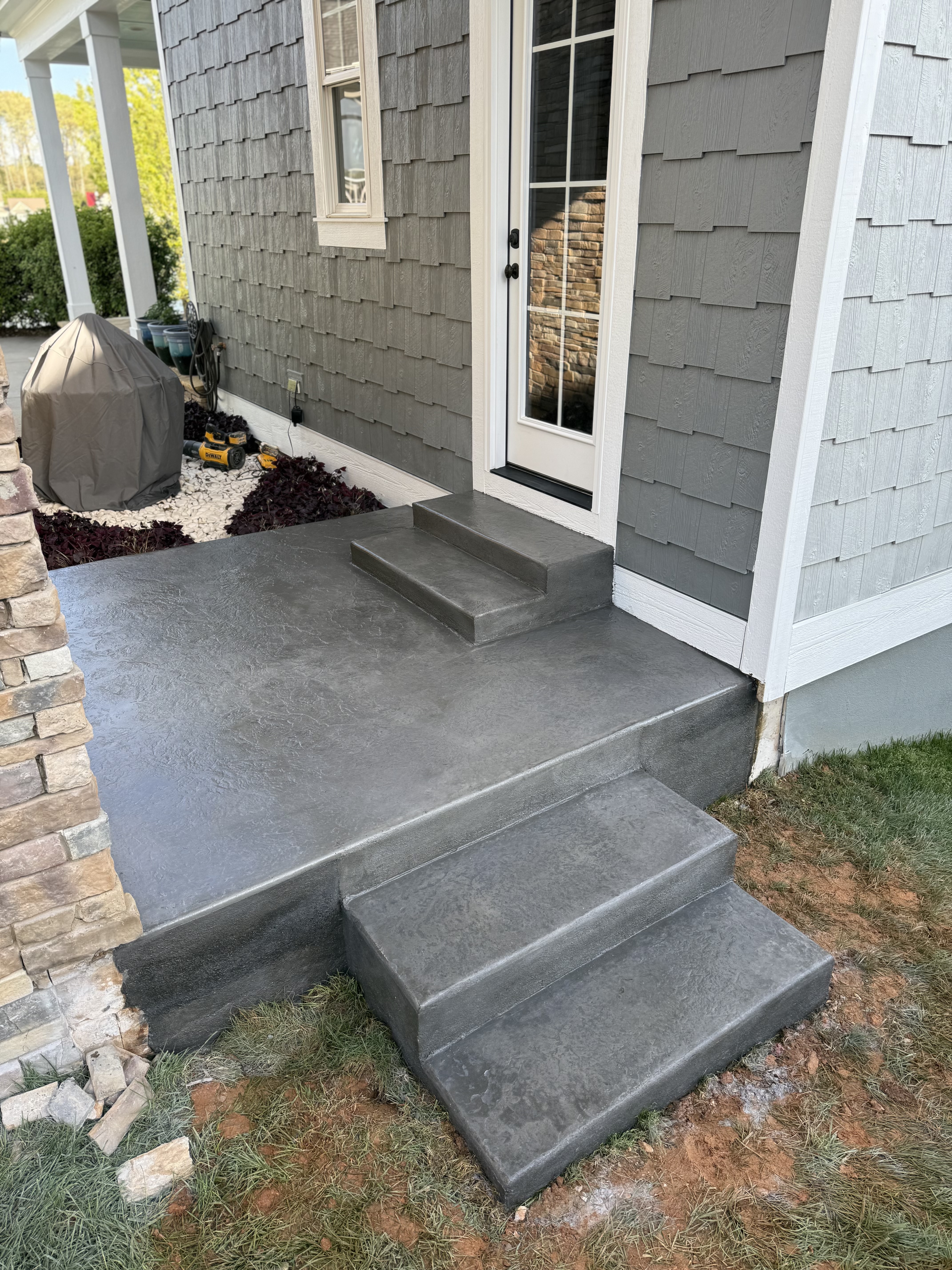
Stamped Concrete
Recent Job
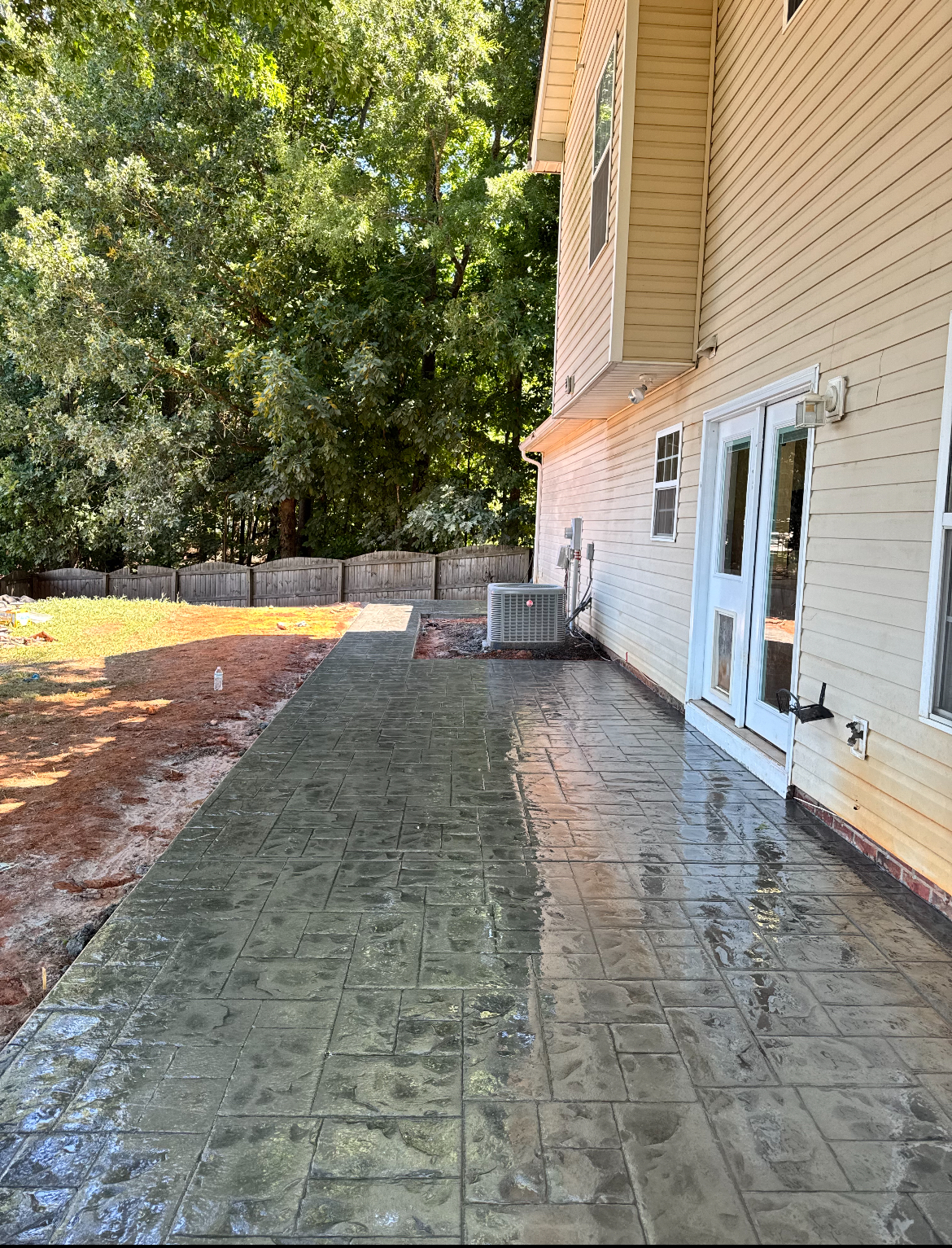
Stamped Concrete
Recent Job
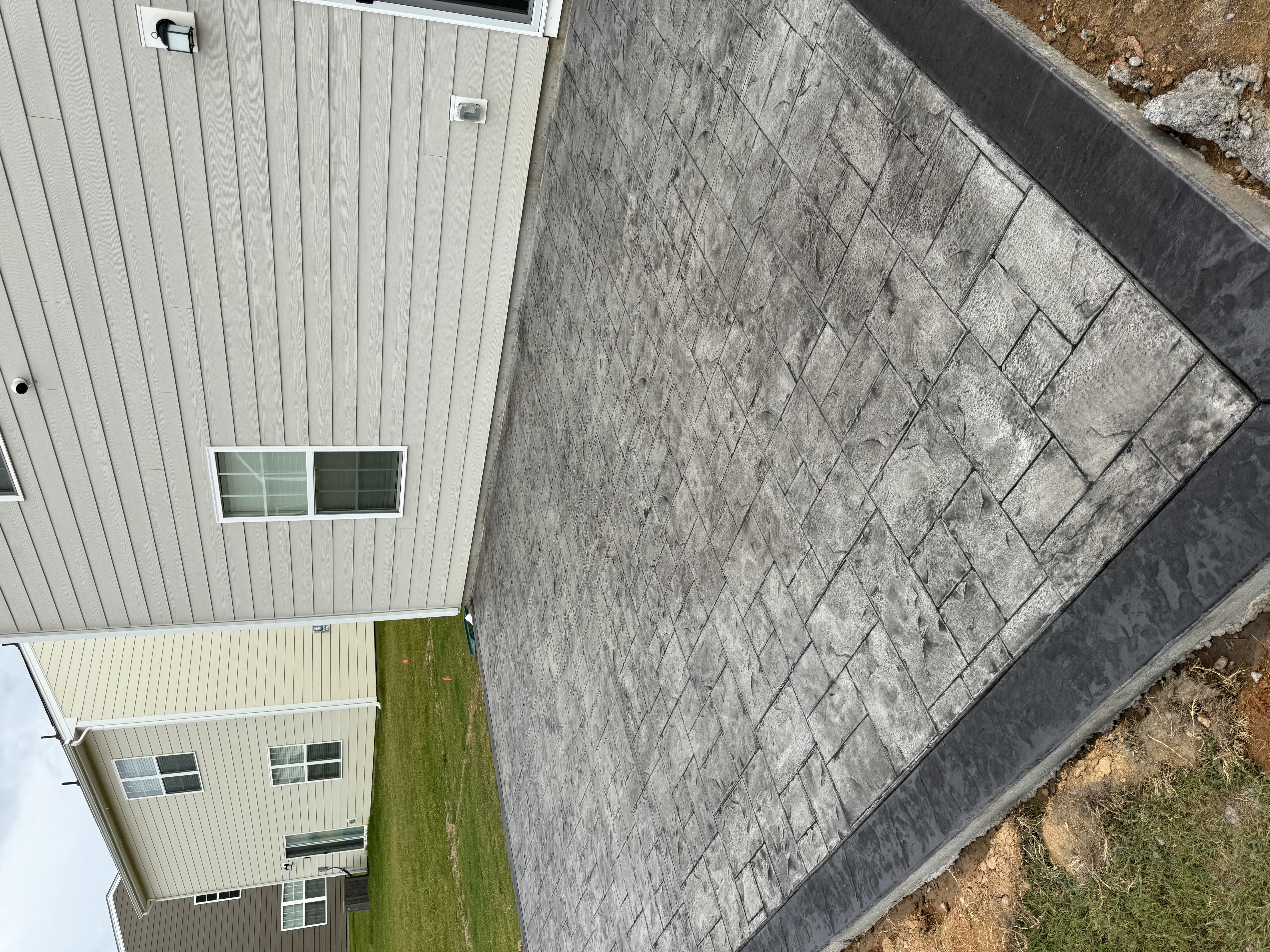
Stamped Concrete
Recent Job
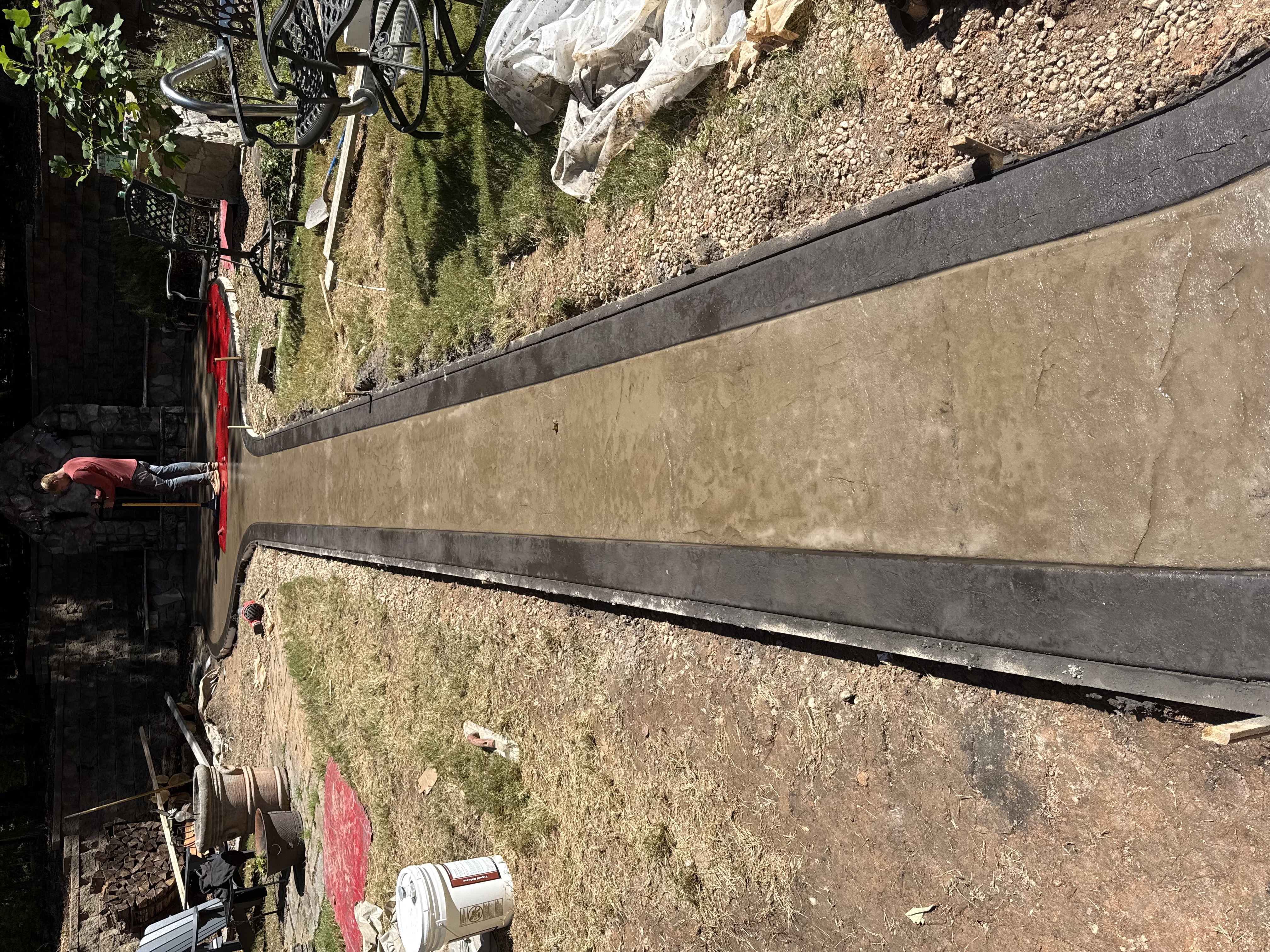
Stamped Concrete
Recent Job
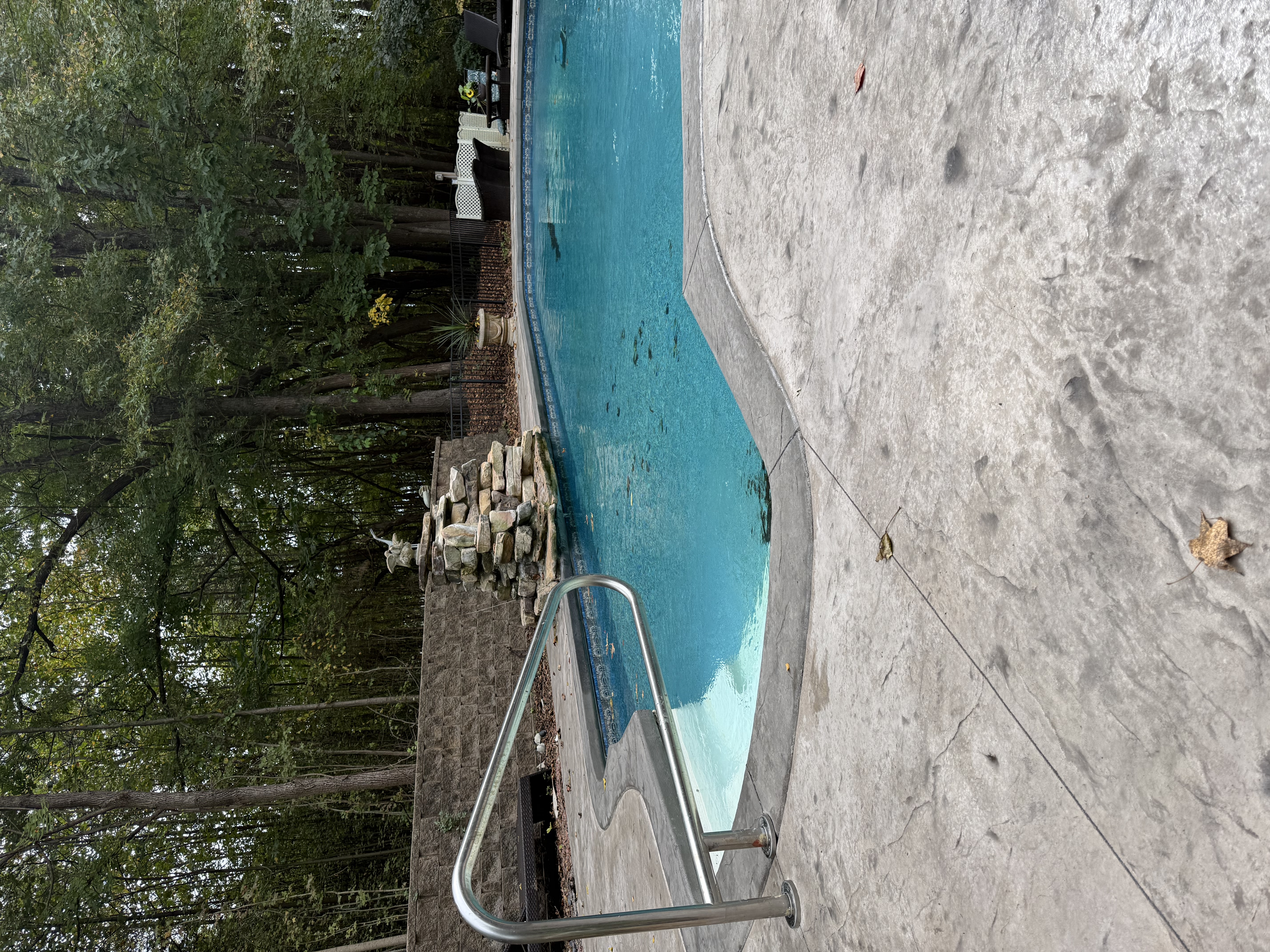
Stamped Concrete
Recent Job
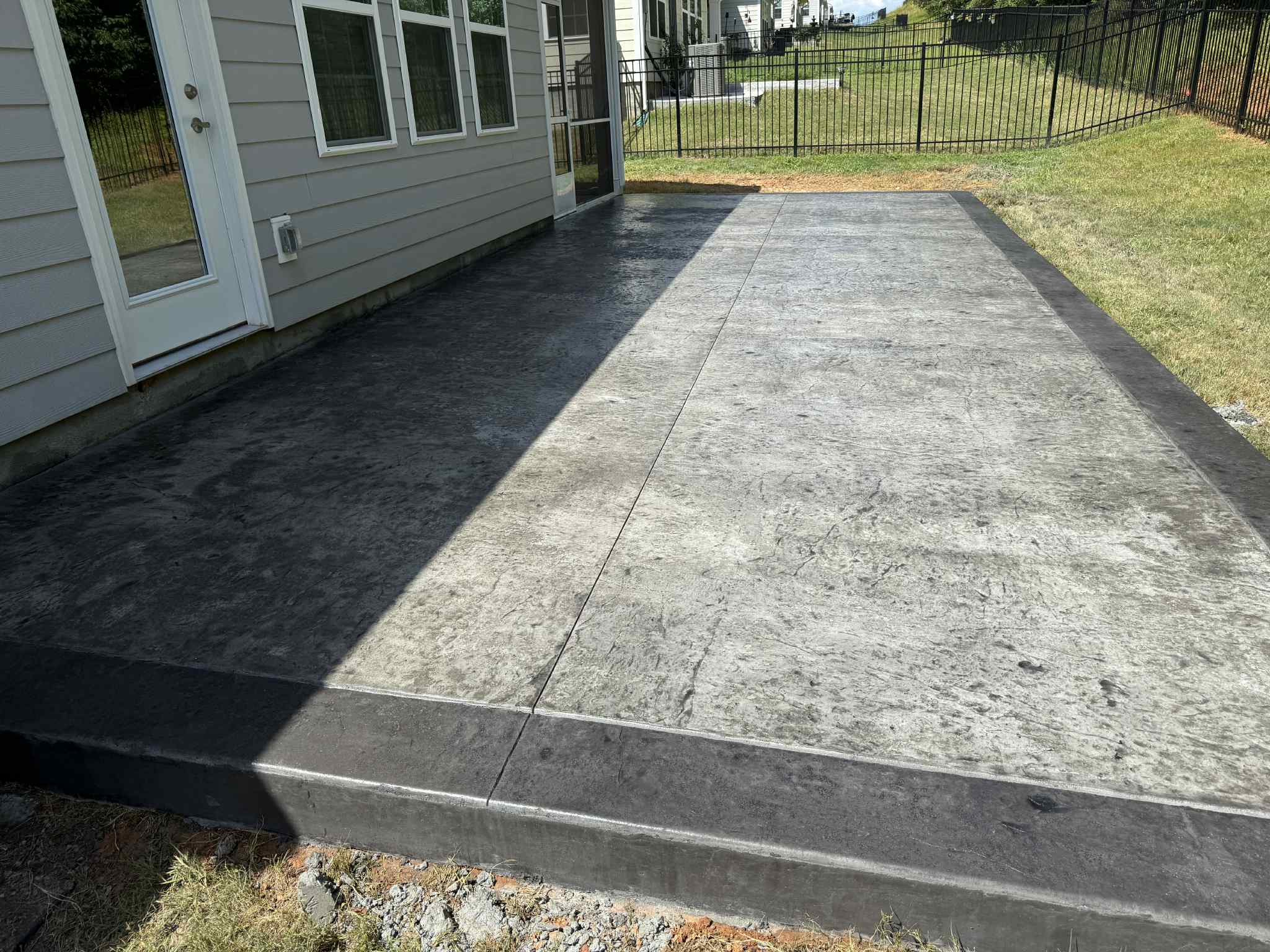
Stamped Concrete
Recent Job
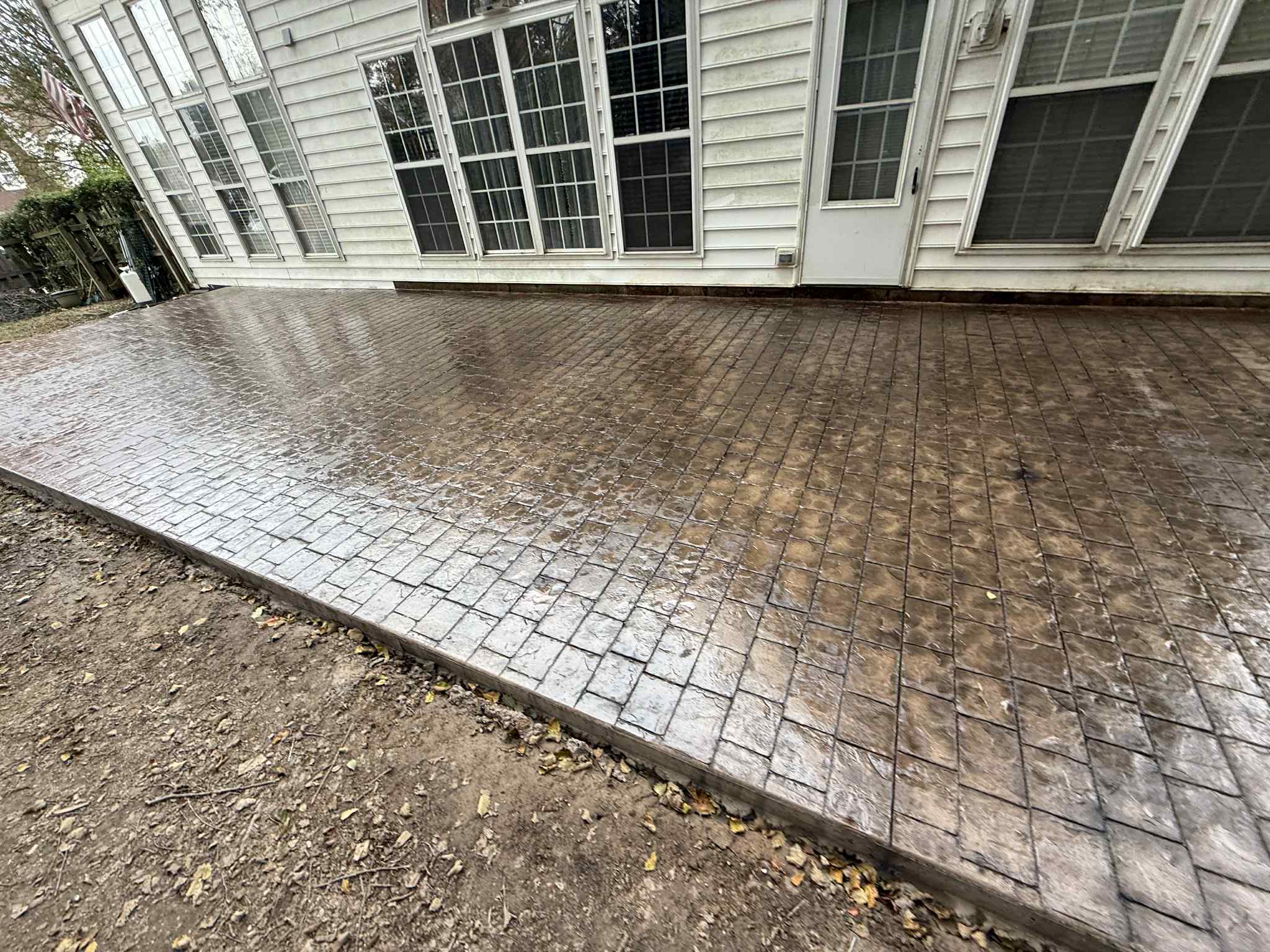
Stamped Concrete
Recent Job
Real Projects We've Completed
A sampling from the Charlotte-metro portfolio — driveways in Ballantyne, patios in SouthPark, porches in Matthews, pool decks in Weddington. Slide each pair below to see the actual before-and-after we shot on the job site.
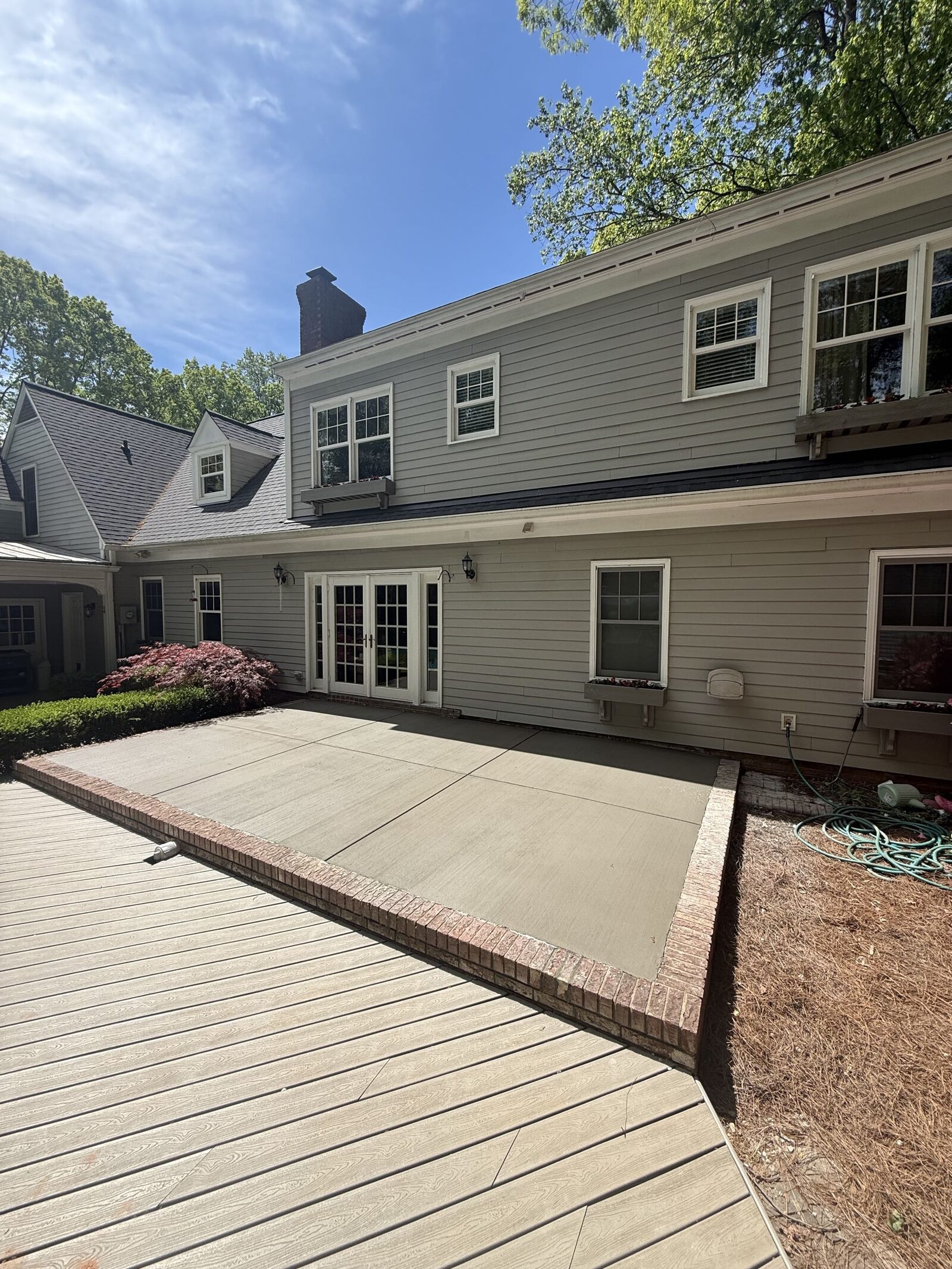

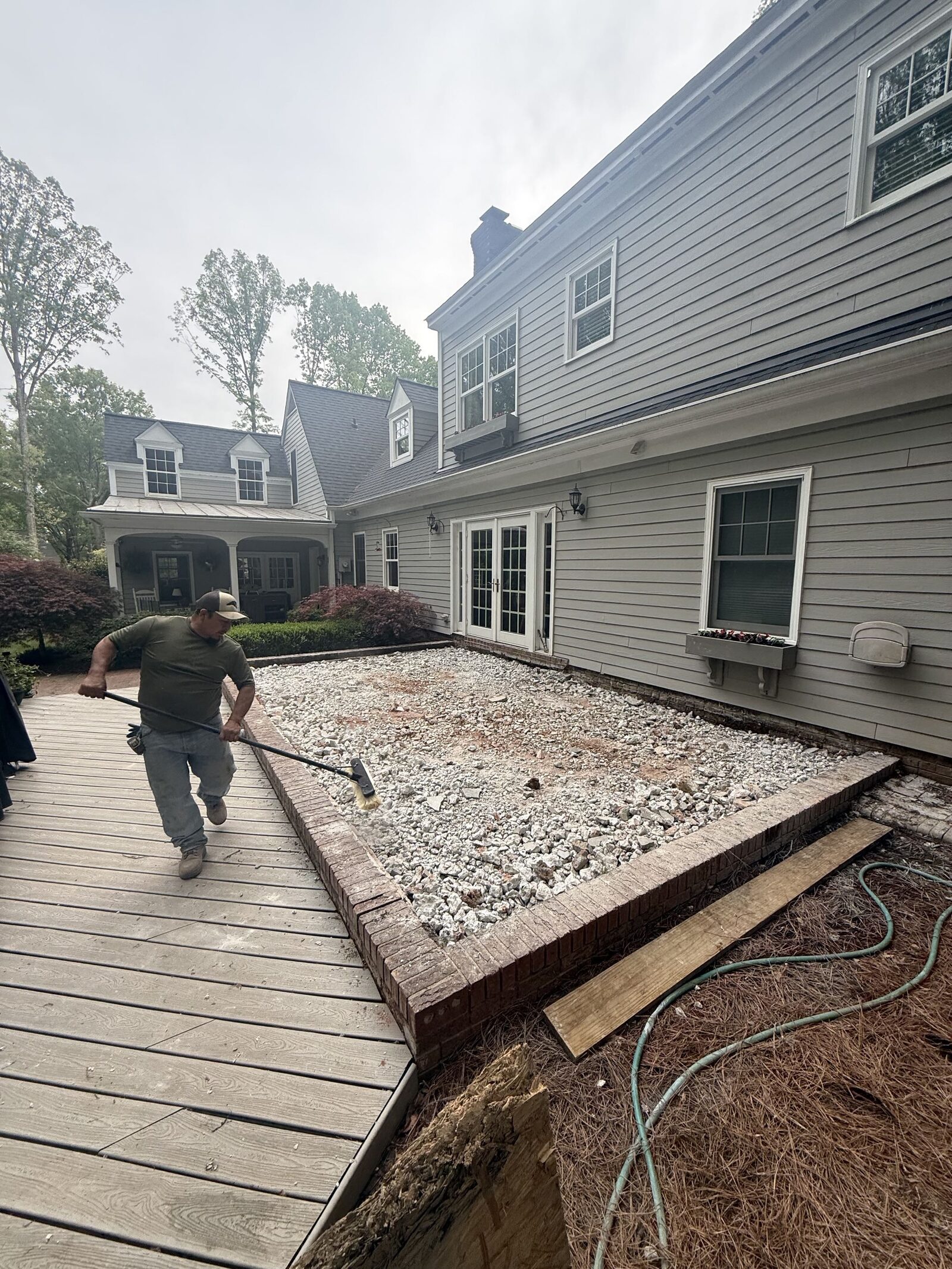
Backyard Patio
Full tear-out, new pour with brick-border detail
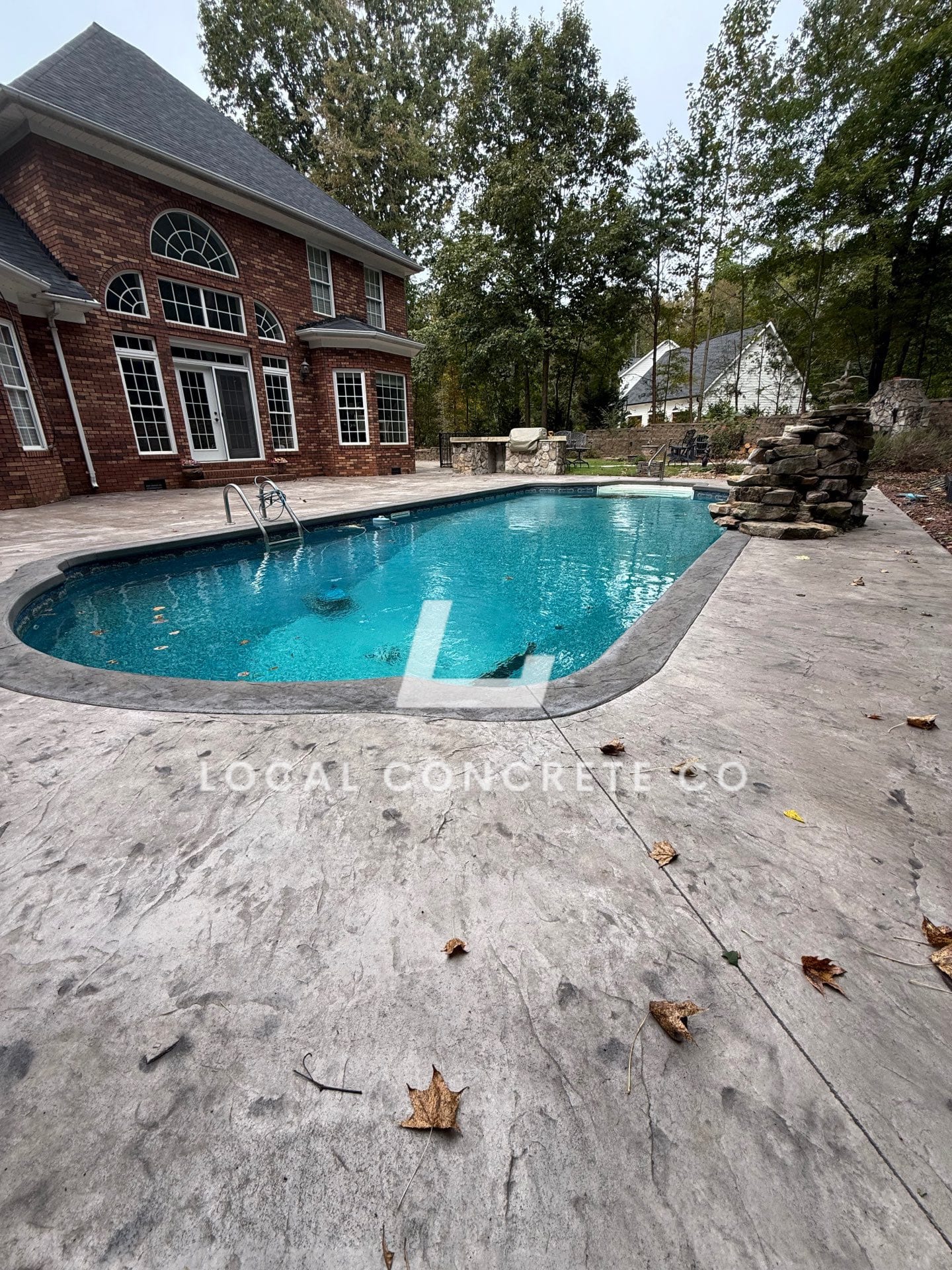
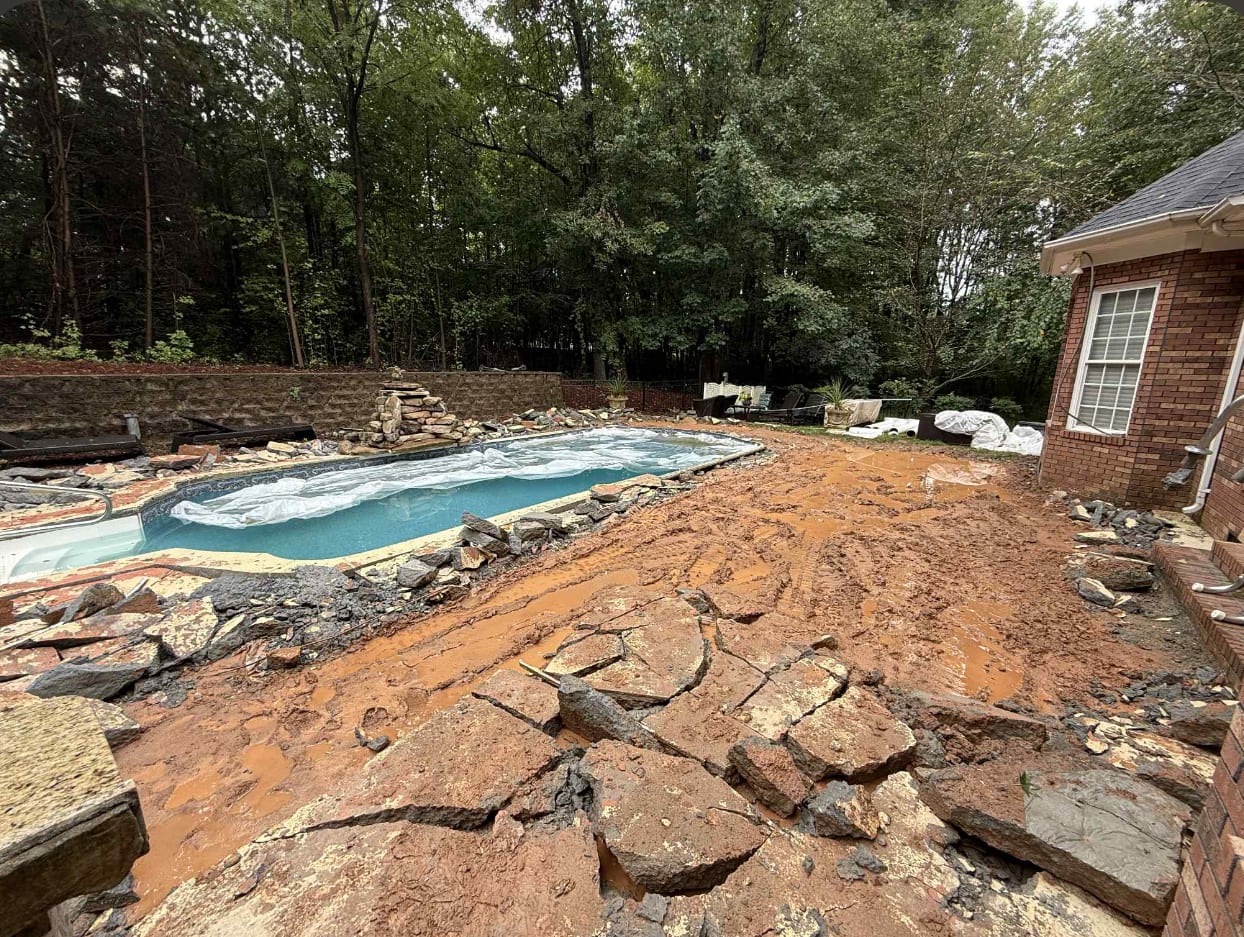
Stamped Pool Deck
Weathered deck replaced with textured stamped pour
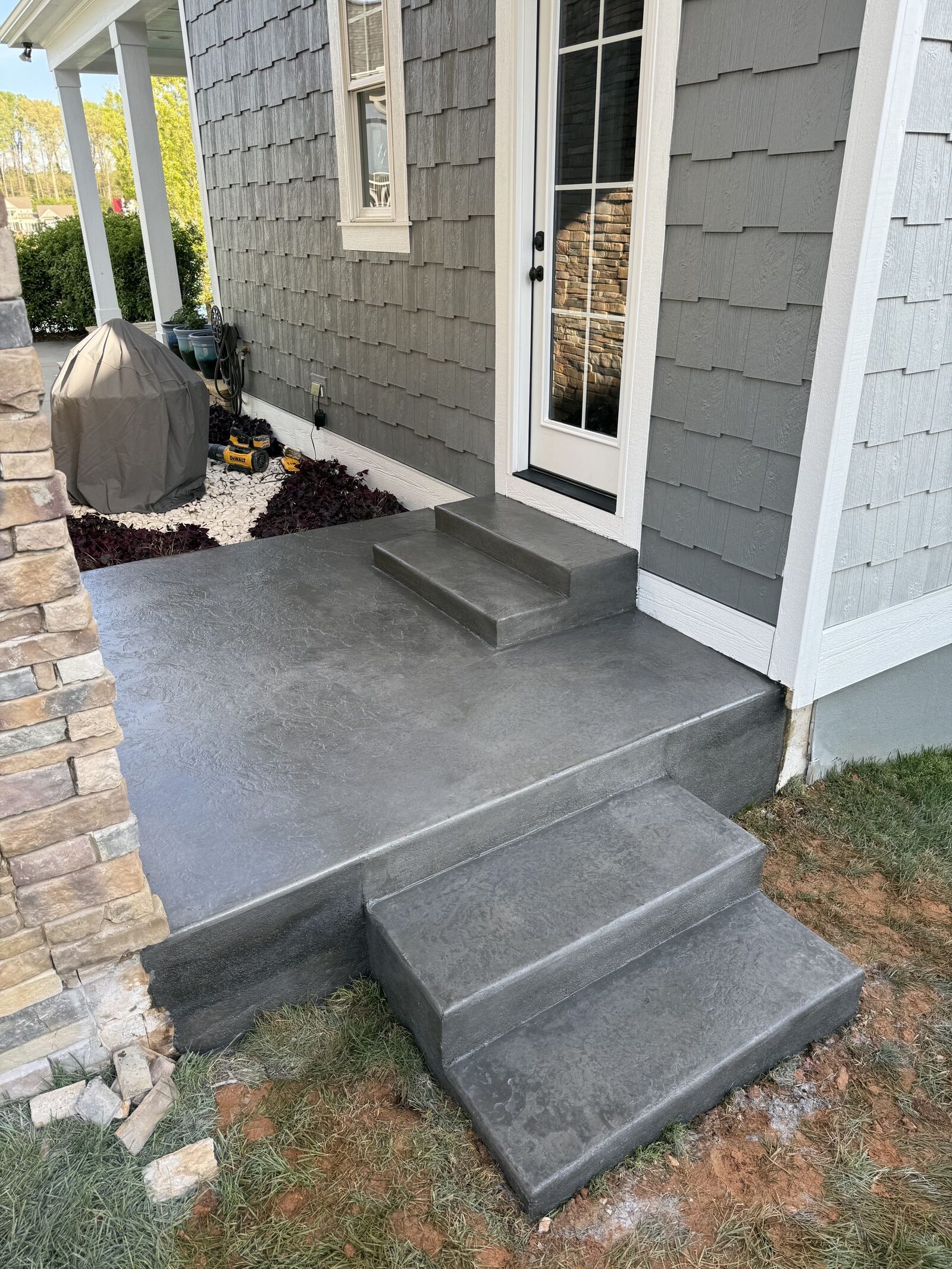
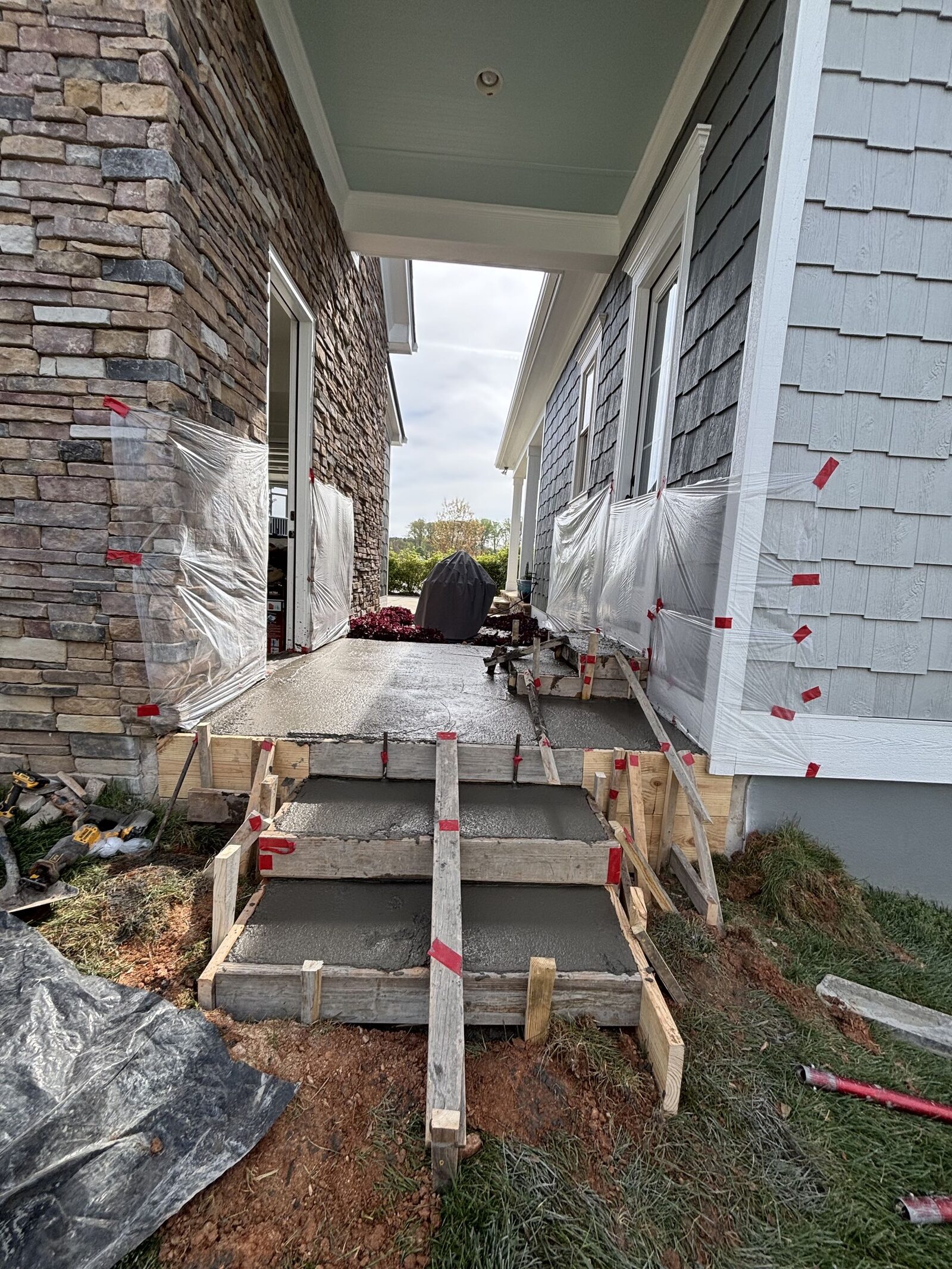
Front Porch & Steps
New entry pad plus poured steps to the door
The process is straightforward on paper: a fresh slab, textured rubber mats pressed into the surface while it's still workable, and the mat pattern transfers as ashlar slate, random flagstone, wood plank, Roman cobblestone, or herringbone brick. Color is what separates a finished slab that reads real from one that reads plastic. Two layers build the tone — an integral pigment that goes into the ready-mix truck for base color, then a dry-shake color hardener broadcast across the wet surface for the topcoat, with a contrasting release powder worked in as the mats come down. Executed well, you get the visual weight of hand-laid masonry without paying for a mason's week.
Local Concrete Charlotte pours stamped work across Mecklenburg and Union counties and the surrounding NC Piedmont. Before a quote gets written, we walk the site — existing grade, drainage direction, sun exposure through the day, and the actual use pattern (kids and patio furniture, foot traffic, occasional vehicle). That walkthrough becomes a written spec covering base prep, mix design, thickness, color layer plan, pattern choice, joint layout, and the sealer schedule you'll follow after the pour. Zero deposit, no pressure tactics, and the invoice at the end matches the quote at the start.
Our Stamped Concrete Services
The category covers a lot of ground, and pattern scale, slab thickness, and joint hiding all shift depending on where the stamped surface lives.
- Patio stamps run in slate ashlar, natural flagstone, cobble, board-plank, and angled brick layouts
- Pool surrounds stamped with a traction-first pattern pick and lighter tones so the deck doesn't bake in July
- Driveway stamps with vehicle-rated slab depth and a pattern grain that won't wear flat under tire loads
- Connector walks between drive and porch, house and patio, plus meandering garden runs
- Stoops and porch pours integrated with existing risers or a matching new stamped tread
- Broom-finish fields wrapped in a stamped decorative edge for a budget-friendlier accent
- Recoloring plus a full sealer reapplication on older stamped pours where the pattern still holds up
- Cut-and-replace panel work where damage runs deeper than a cosmetic patch can handle
Residential drives, patios, pool decks, and walkways are all fair game for stamped. It isn't the right finish for a commercial loading dock, a truck turnaround pad, or any surface that sees steel-tracked equipment. Those get a broom or exposed-aggregate spec instead.
Why Homeowners Choose Stamped Over Pavers or Natural Stone
On a residential outdoor surface, stamped concrete delivers the look of natural stone without the labor time of hand-laid masonry or the ongoing joint work a paver install creates. Because a stamped slab is one continuous pour, there are no individual stones to shift out of plane, no polymeric sand to re-sweep every couple of seasons, and no weed lines running up through the grout.
What stamped gives you:
- Flagstone, slate, or cobble presence for a lower total cost than paying a mason to set each unit
- A single monolithic slab means nothing settles unevenly, nothing needs re-leveling, and grout lines don't sprout crabgrass
- Pigment blended into the mix rather than a topcoat stain that thins along the walking lanes
- Repeatable pattern across driveway, walkway, and patio so the property reads as one design
- Quicker completion window than laying the same square footage in pavers or cut stone piece by piece
- The upkeep loop is a periodic resealing rather than yearly joint sanding or shifting-unit repairs
Three trade-offs come with the finish: a re-seal on a three to five year rhythm to keep the pattern crisp and the color from graying, saw-cut control joints that steer where cracking will develop, and a slower initial cure than a broom-finish slab because the hardener and release agent both slow the top-paste set. None of the three are dealbreakers when the spec is right up front.
Get your free quote
We respond in less than 2 hours.
Why Local Concrete Charlotte?
- 01.Charlotte-metro crews, one trade
- 02.Line-item pricing, nothing hidden
- 03.One foreman from bid to walkthrough
- 04.Pay after the pour, never before
Our Concrete Installation Process
Every stamped concrete we pour runs through the same 18 checkpoints — from the on-site consult through the final walkthrough.
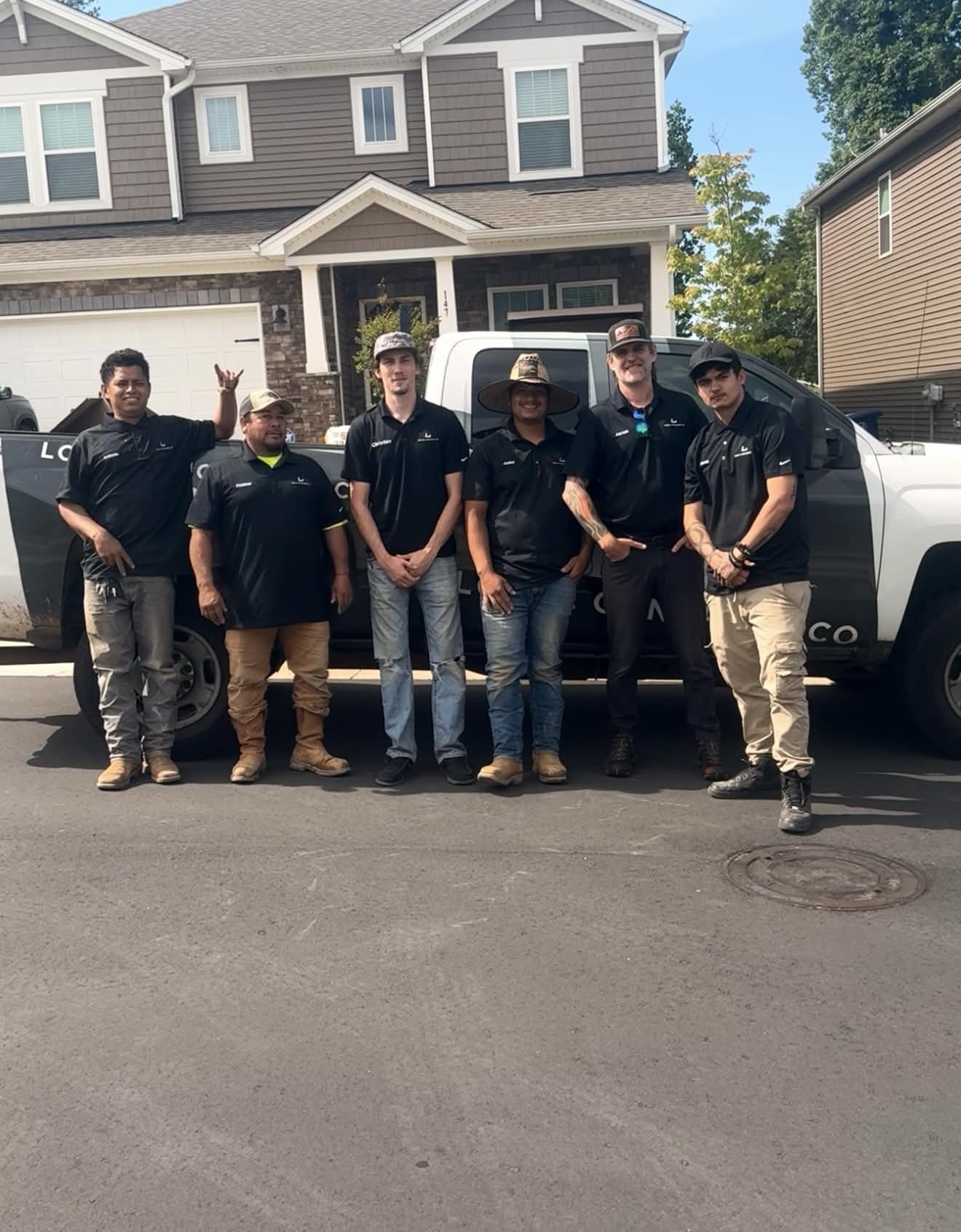
Consultation & Estimate
A crew lead walks your Charlotte-metro pad, shoots laser measurements across the footprint, notes tear-out volume plus pump-truck approach from the curb, and drops a fixed all-in bid in your inbox by the next business day.

Logistics & Scheduling
Crew calendar, pump availability, and Piedmont radar all get cross-referenced before your pour date locks in. Any front tracking through the 485 corridor inside a 48-hour window triggers a proactive reschedule call — never a rain-day gamble.

Custom Mix Design
Charlotte summers push 91F and the region sees 22 freeze-thaw cycles a year — both demand different mix chemistry. The batch plant hears from us the afternoon before with air-temp targets, slump range, retarder dose, and entrained-air percentage dialed in.
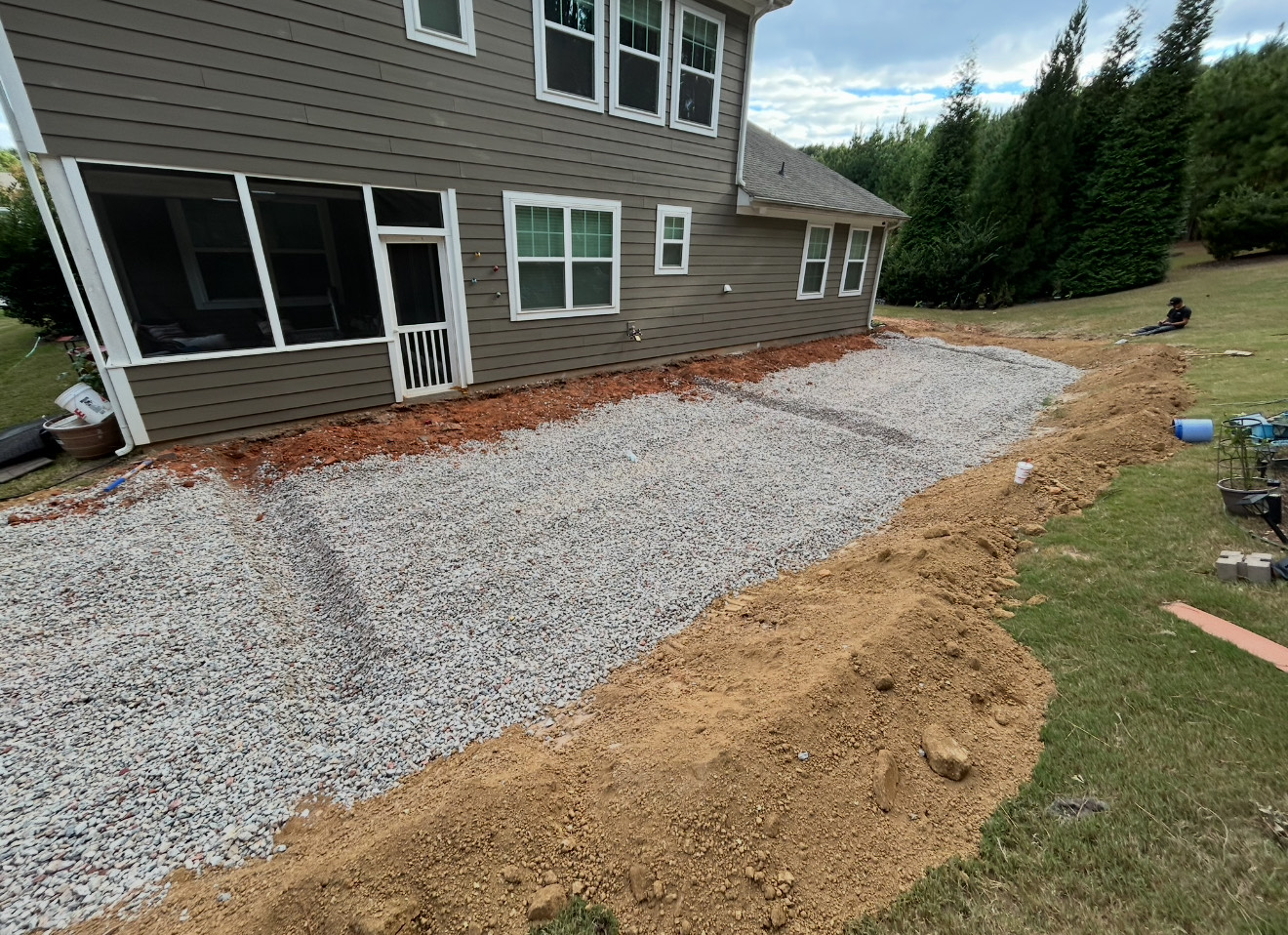
Site Preparation
Three-quarter-inch plywood gets staged over any turf the pump line crosses, ornamental beds around the pad get tarped, and the pump driver confirms his Mecklenburg approach route with the foreman before wheels touch the drive.
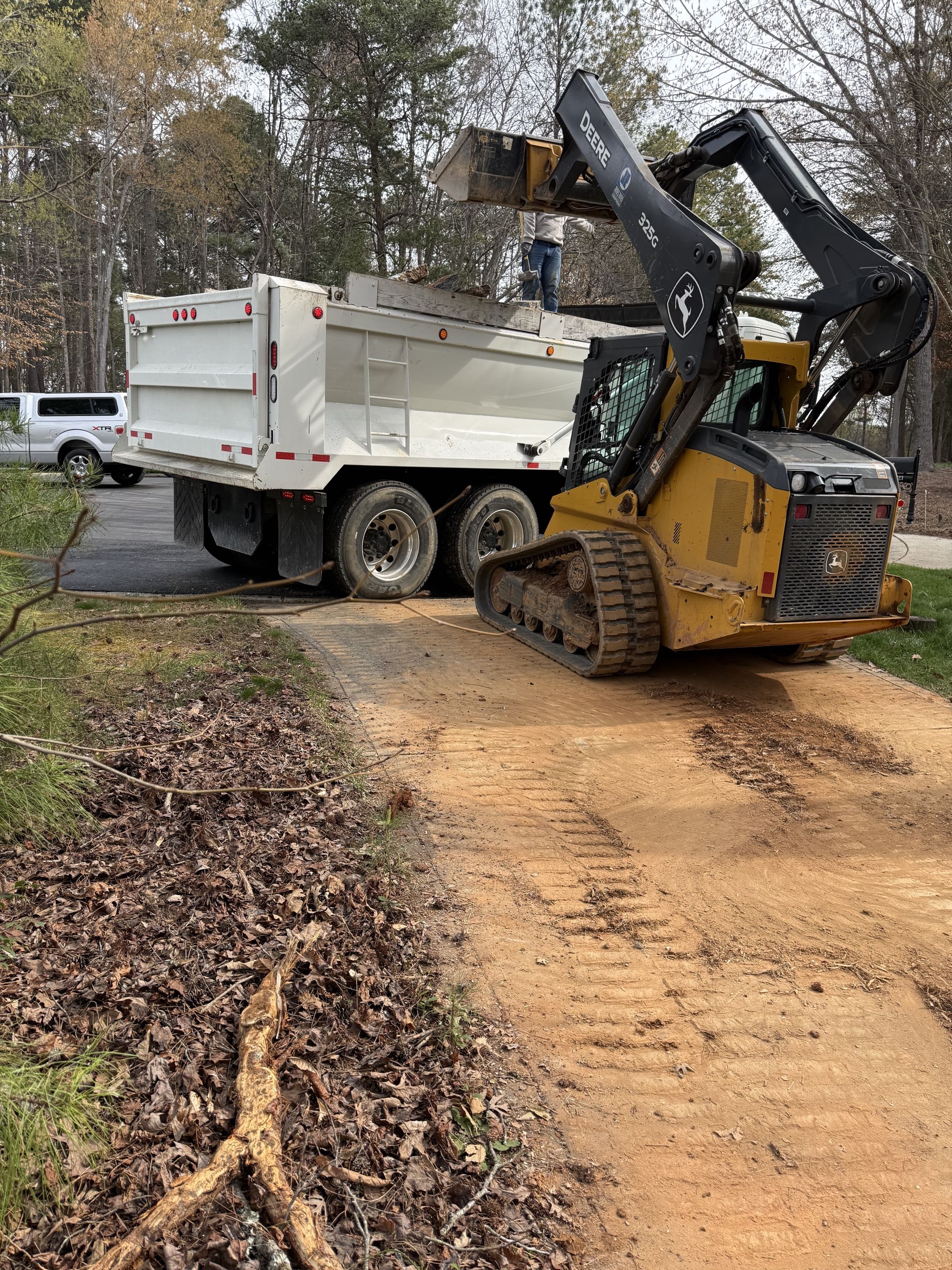
Demolition
Anything under six inches gets broken up by hydraulic hammer; reinforced sections get saw-cut into panels and pried out. A skid-steer loads every fragment straight into the dump truck — no rubble pile lingering on your property overnight.
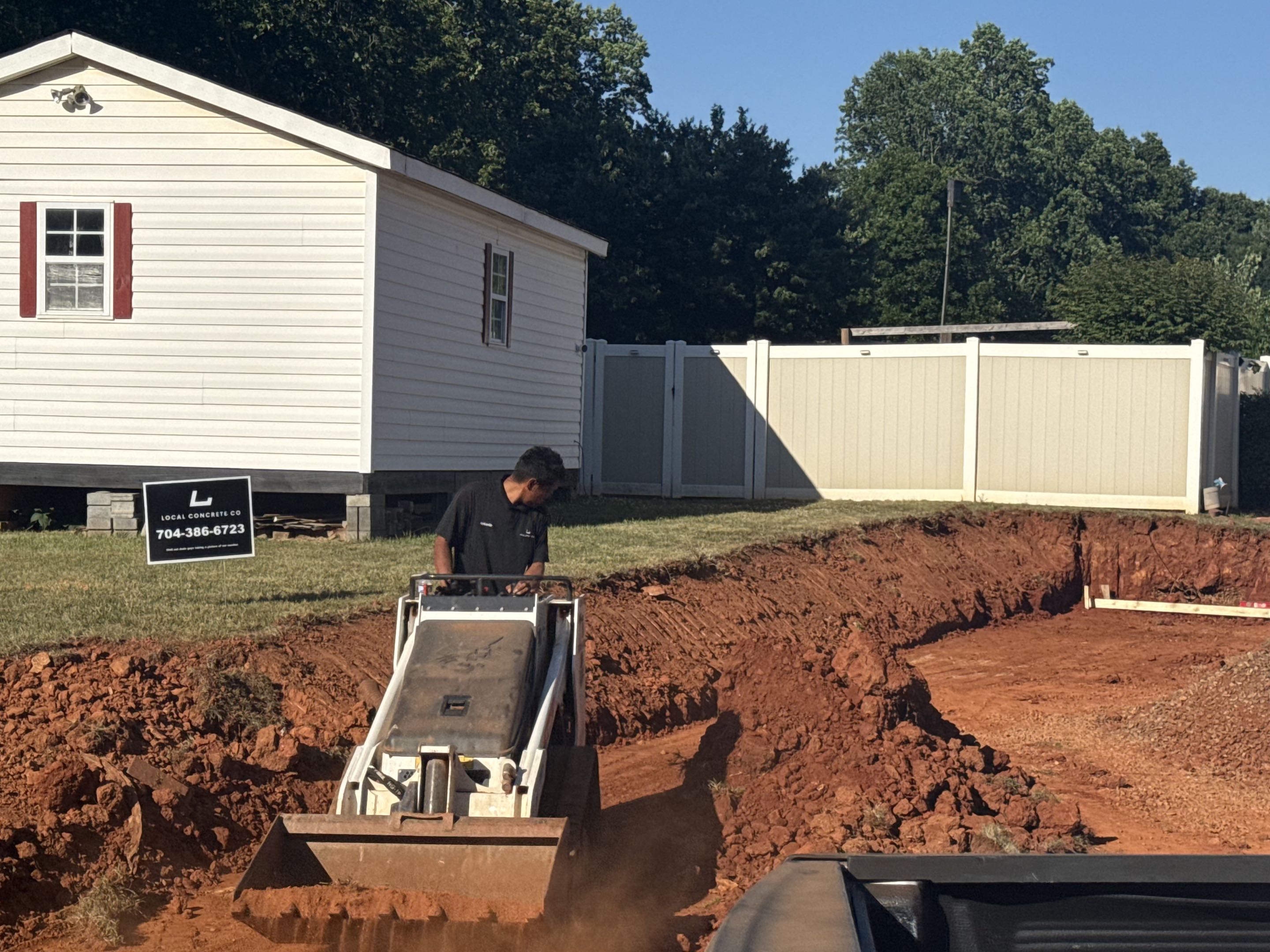
Grading & Forming
A compacted #57 stone base of four to six inches goes down in two lifts on every subgrade — critical over Piedmont red clay, which swells wet. Laser confirms a minimum 1/8-inch-per-foot fall away from the foundation, then 2x forms stake off at 32-inch centers.
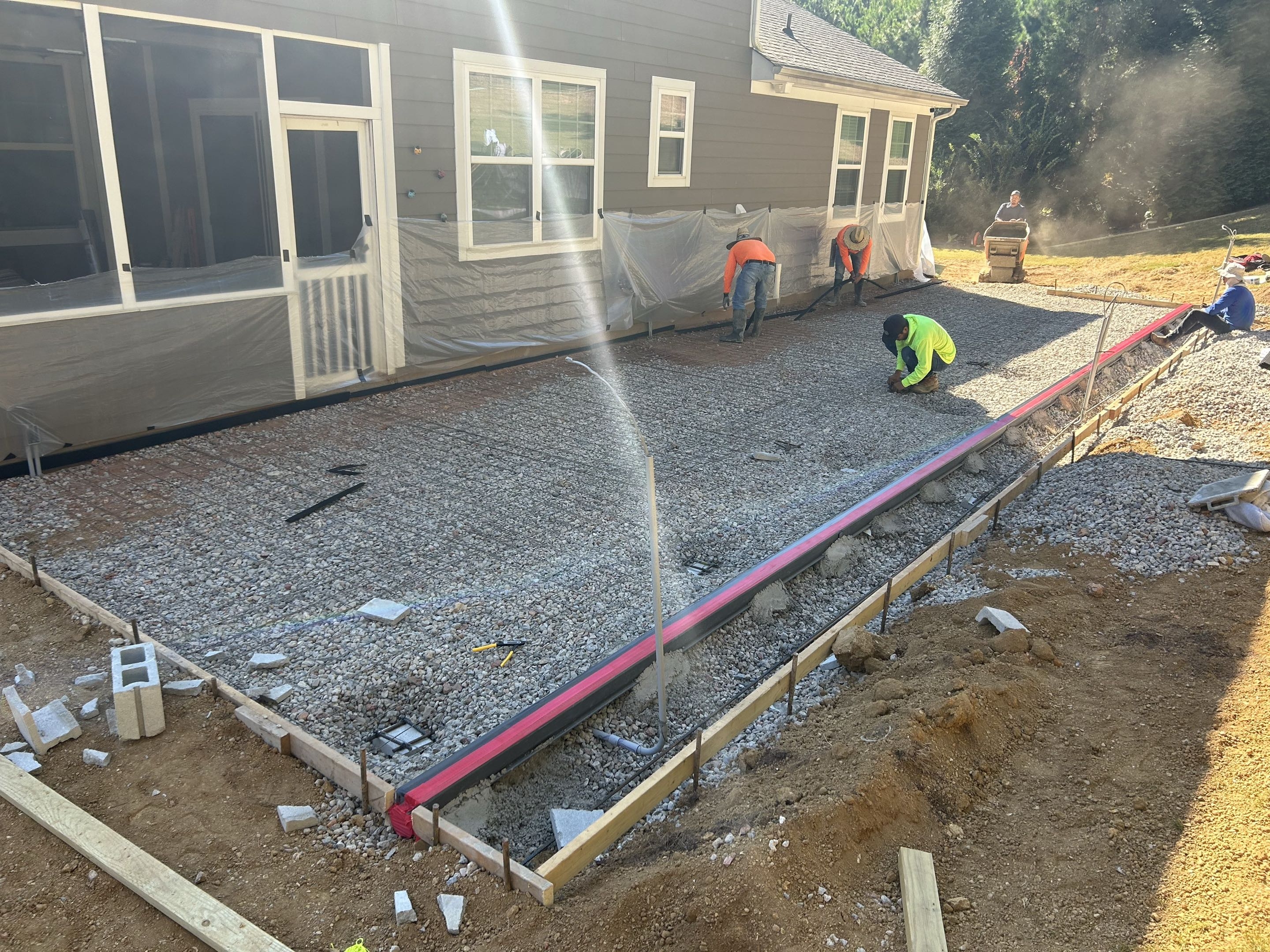
Reinforcement
Grade-60 #4 rebar ties on 18-inch centers into a full grid, seated on chairs so the steel actually rides mid-slab where tension loads live. Red-clay shrink-swell chews through wire mesh in this region — we stopped installing mesh after enough callbacks to know better.
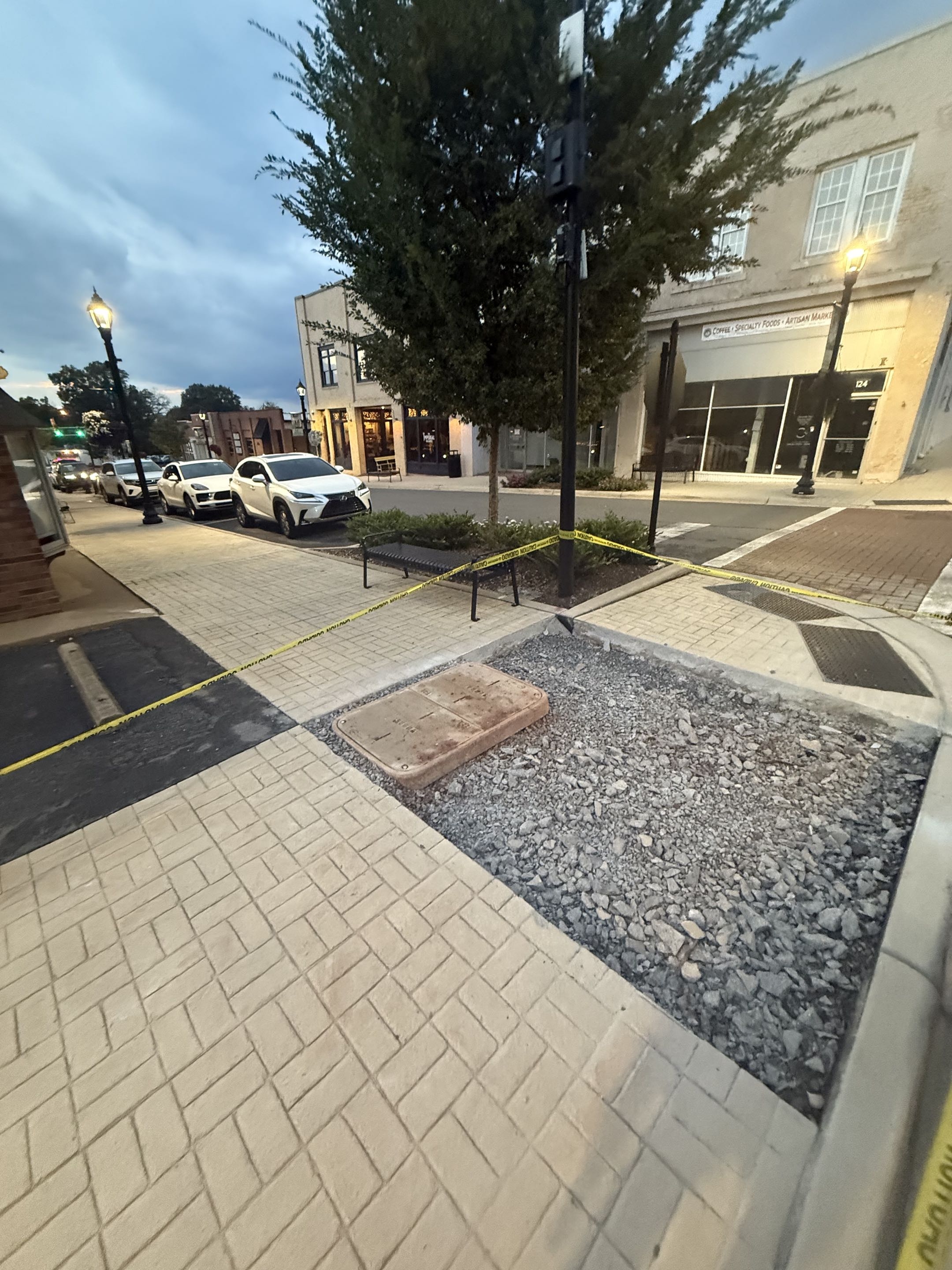
Pre-Pour Inspection
You and the foreman walk the formwork together — form elevations rechecked with the laser, rebar count photographed for the job file, drainage pitch verified end-to-end. This is the last window to catch anything before post-pour changes turn into demo invoices.
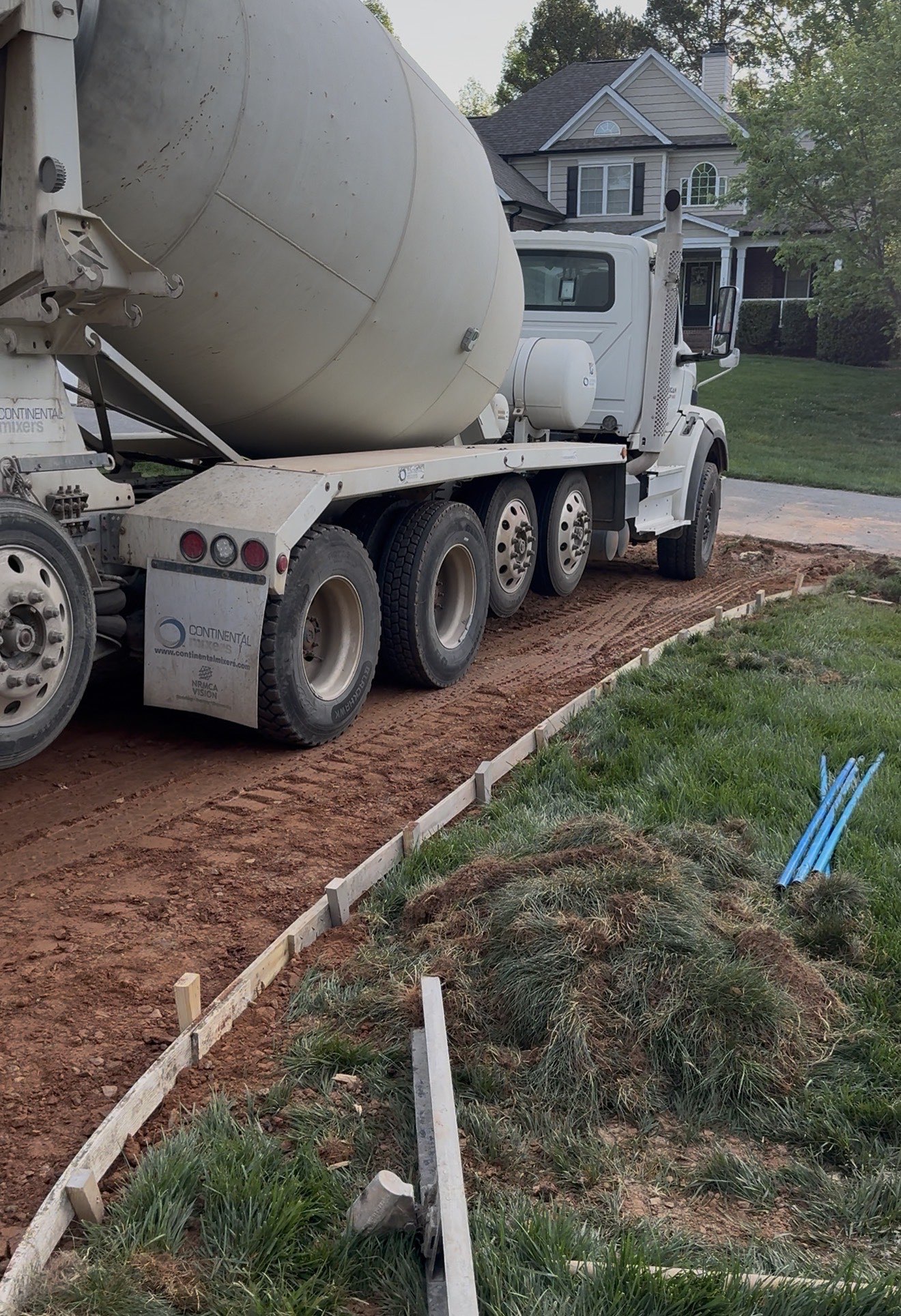
Slump Testing
Every truck arriving gets its first yard cone-tested against the mix ticket before anything moves further down the chute. Numbers outside spec send that truck back to the plant — the pour waits, the slab never inherits a compromised batch.
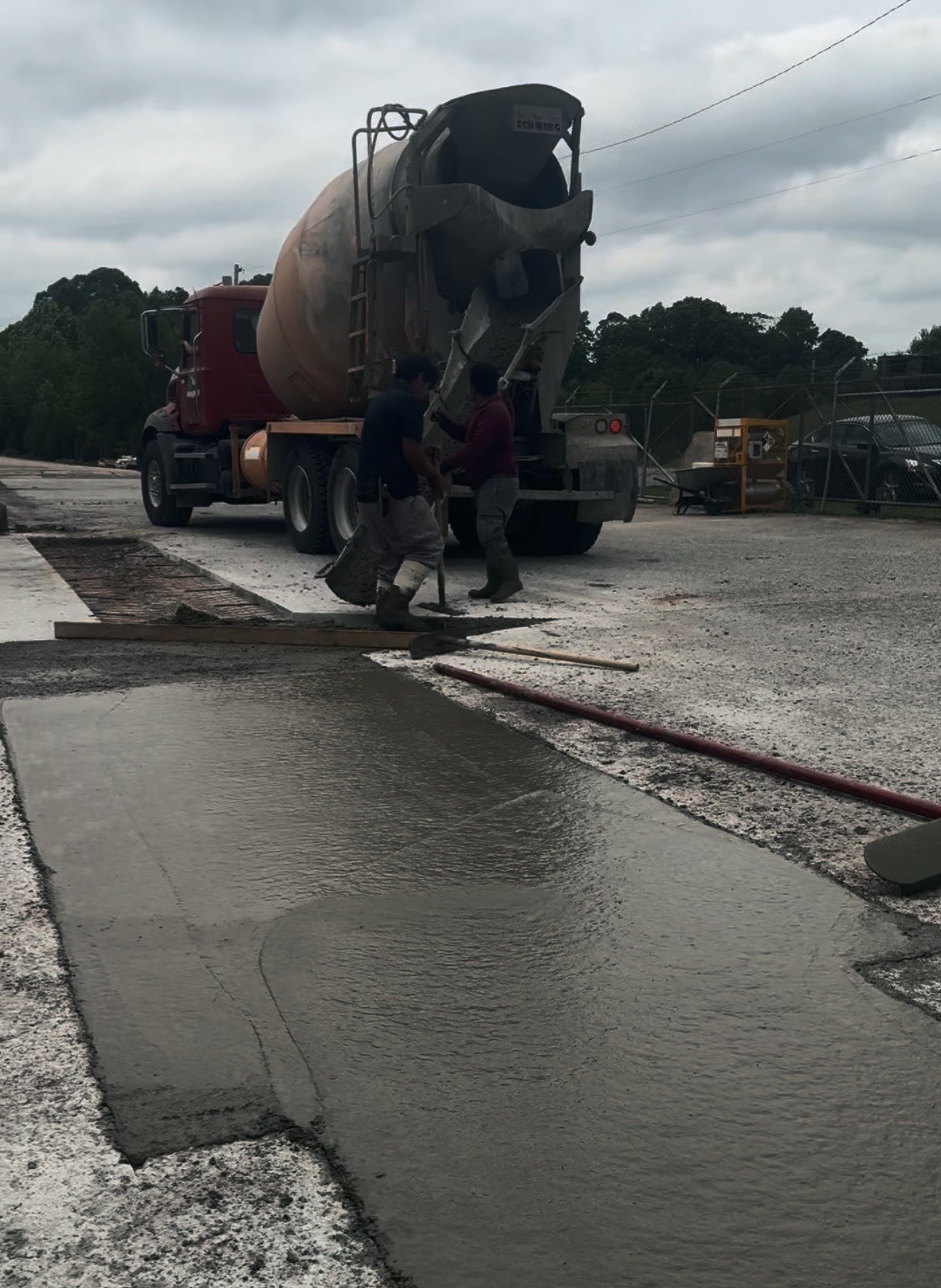
Placement
The pump line advances one direction across each slab section while a screed follows behind in real time, keeping the leading edge wet-on-wet. No mid-slab pauses, no stiffened edges left waiting to bond against fresh concrete from the next truck.
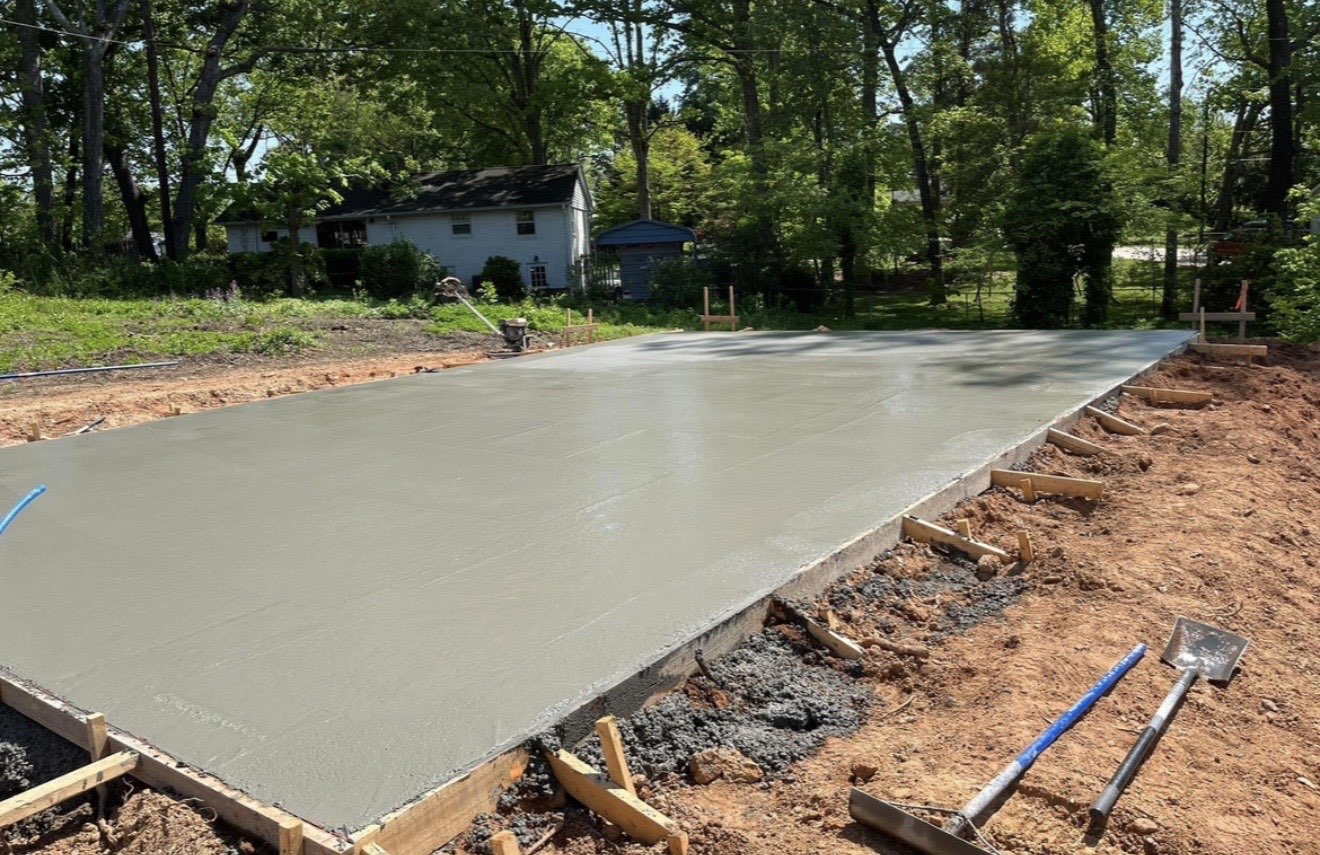
Bull Floating
Immediately behind the screed, the bull-float rides across to press aggregate down and float cement paste to the top. That first surface closure is what decides whether a low-angle Carolina winter sun reveals a flat pour — or a wavy one.
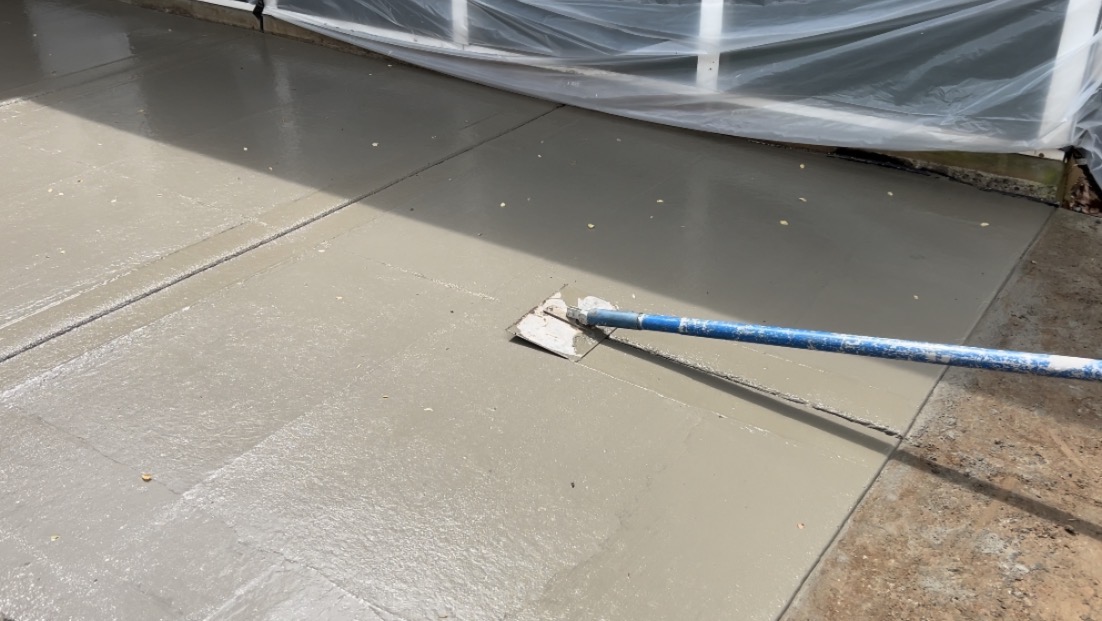
Edging & Jointing
Perimeter edges get hand-tooled round to shed impact loads, and saw-cut control joints go in within a four-to-eight-hour finishing window. Leave it longer over Charlotte clay and random cracks beat you to it. Joint spacing in feet mirrors slab thickness in inches, aligned to columns.
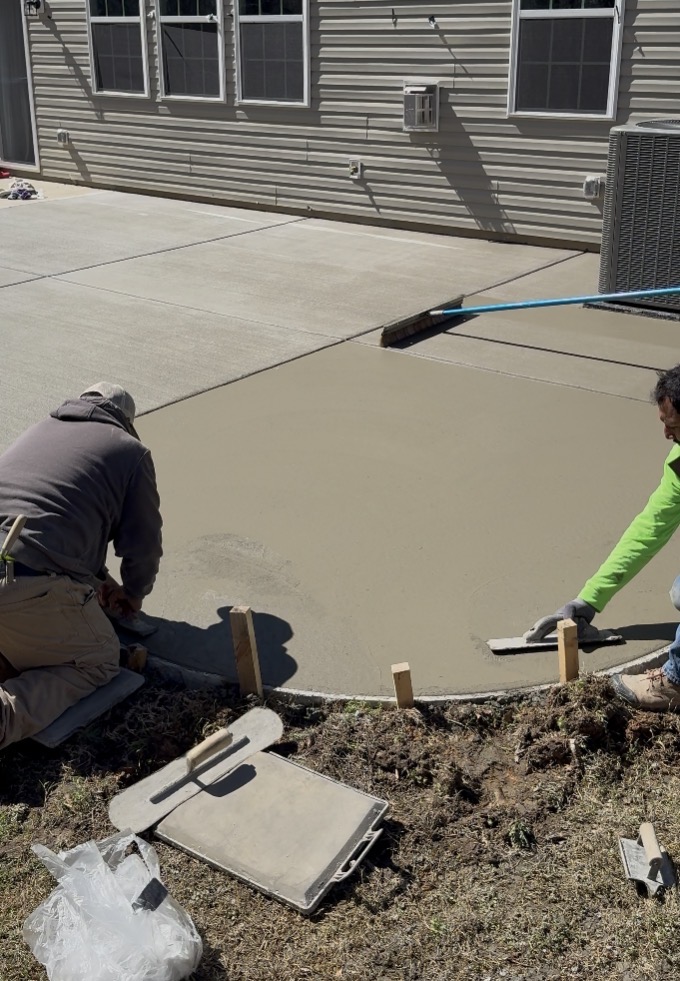
Fresno Finish
A long-handled Fresno makes a second pass to tighten the surface and pull any remaining waves flat. That judgment call — how many passes, when to stop — is exactly what separates a professional finish from a weekend attempt.
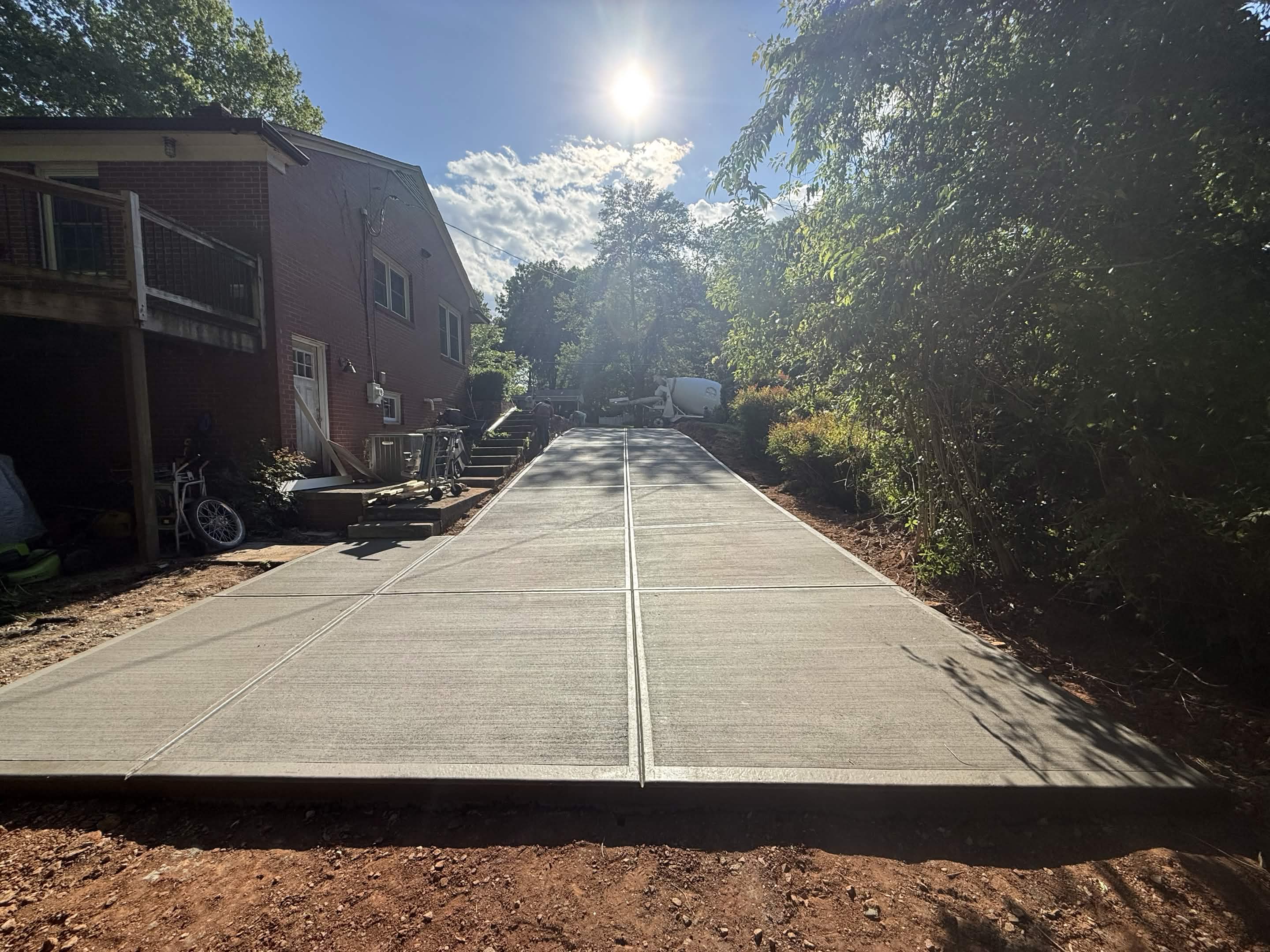
Decorative Detailing
Broom texture drags perpendicular to the direction cars or feet travel, for grip. Stamped patterns get pressed into concrete still holding fingerprint firmness. Exposed aggregate runs a retarder and wash sequence timed to that day's evaporation rate.
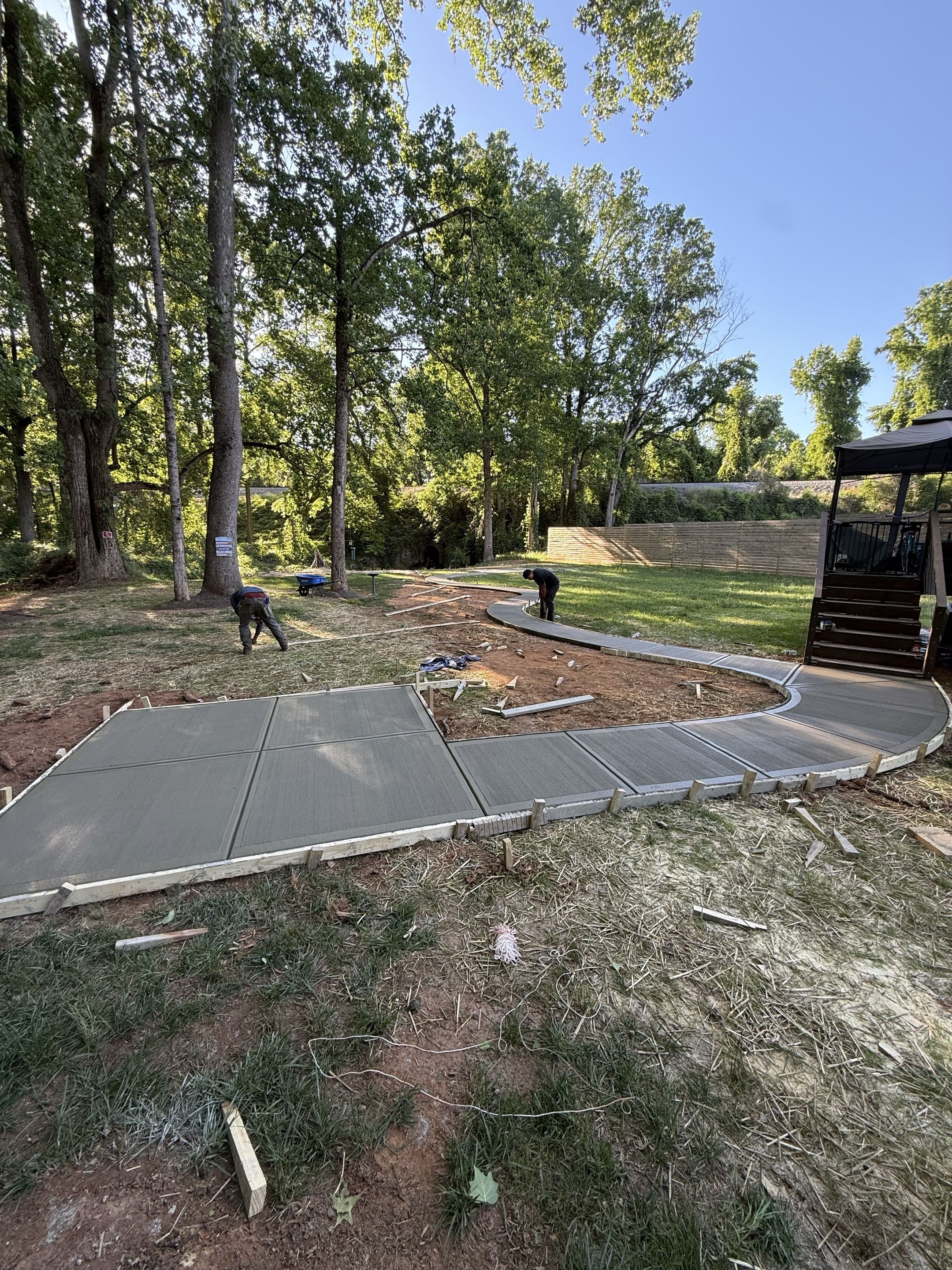
Form Removal
Twenty-four hours is the earliest forms come off — pull sooner and green edges spall, pull later and the stakes fuse to concrete. Flash gets chipped clean, a final chamfer tooled on every exposed edge, then lumber loaded and gone that afternoon.
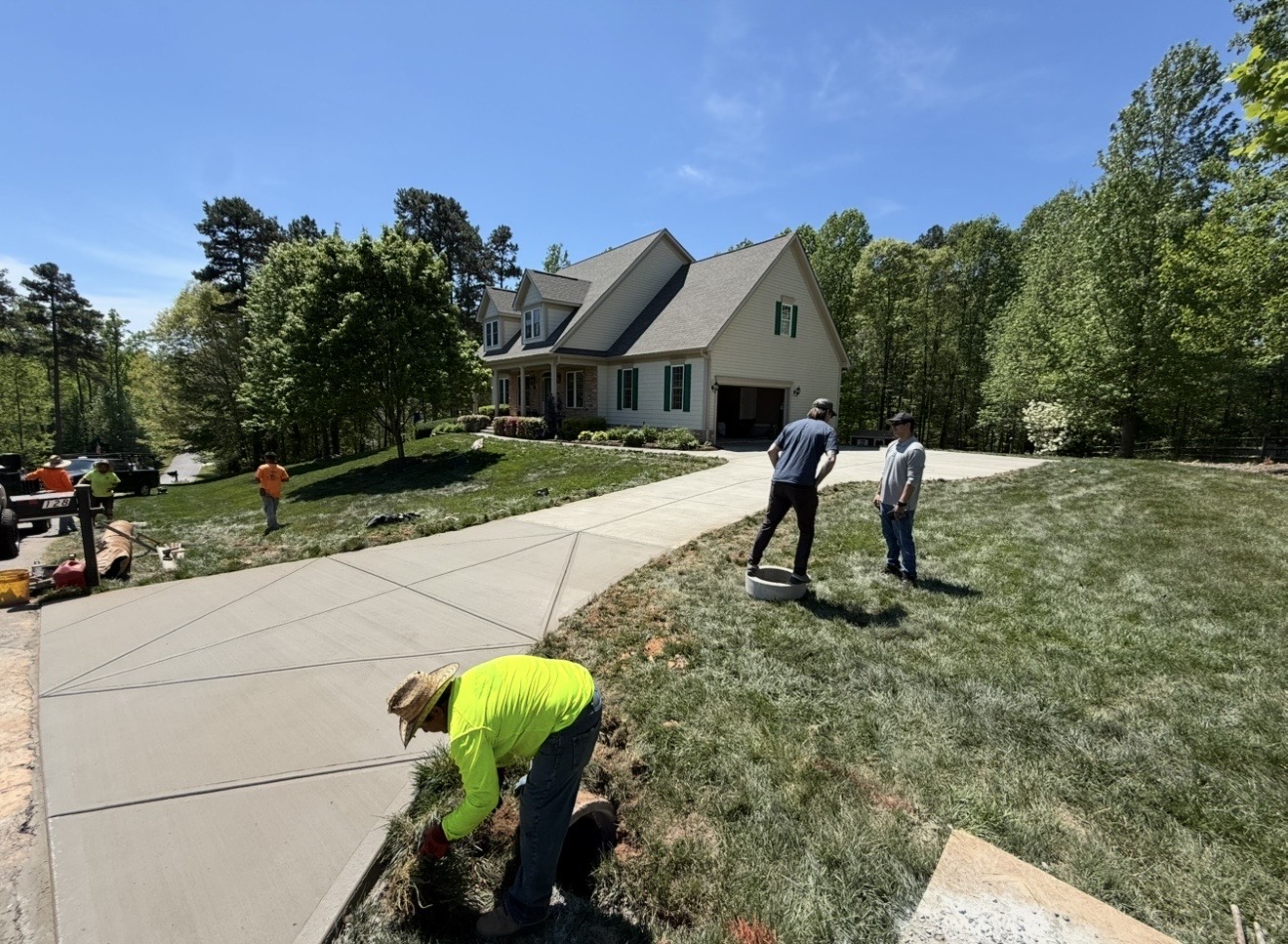
Final Walkthrough
Once the slab is finished, you and the foreman walk it together. Every question — a joint that looks wide, a spot that reads high, a texture line — gets addressed on the spot. Your invoice only hits after you sign off, never before.

Usage Guide
A printed care sheet stays with you: foot traffic at 24 hours, passenger vehicles at 7 days, heavy loads at the full 28-day cure. Also included — a written no-deicing-salt warning for the first winter, and a reseal window for any stamped surface.
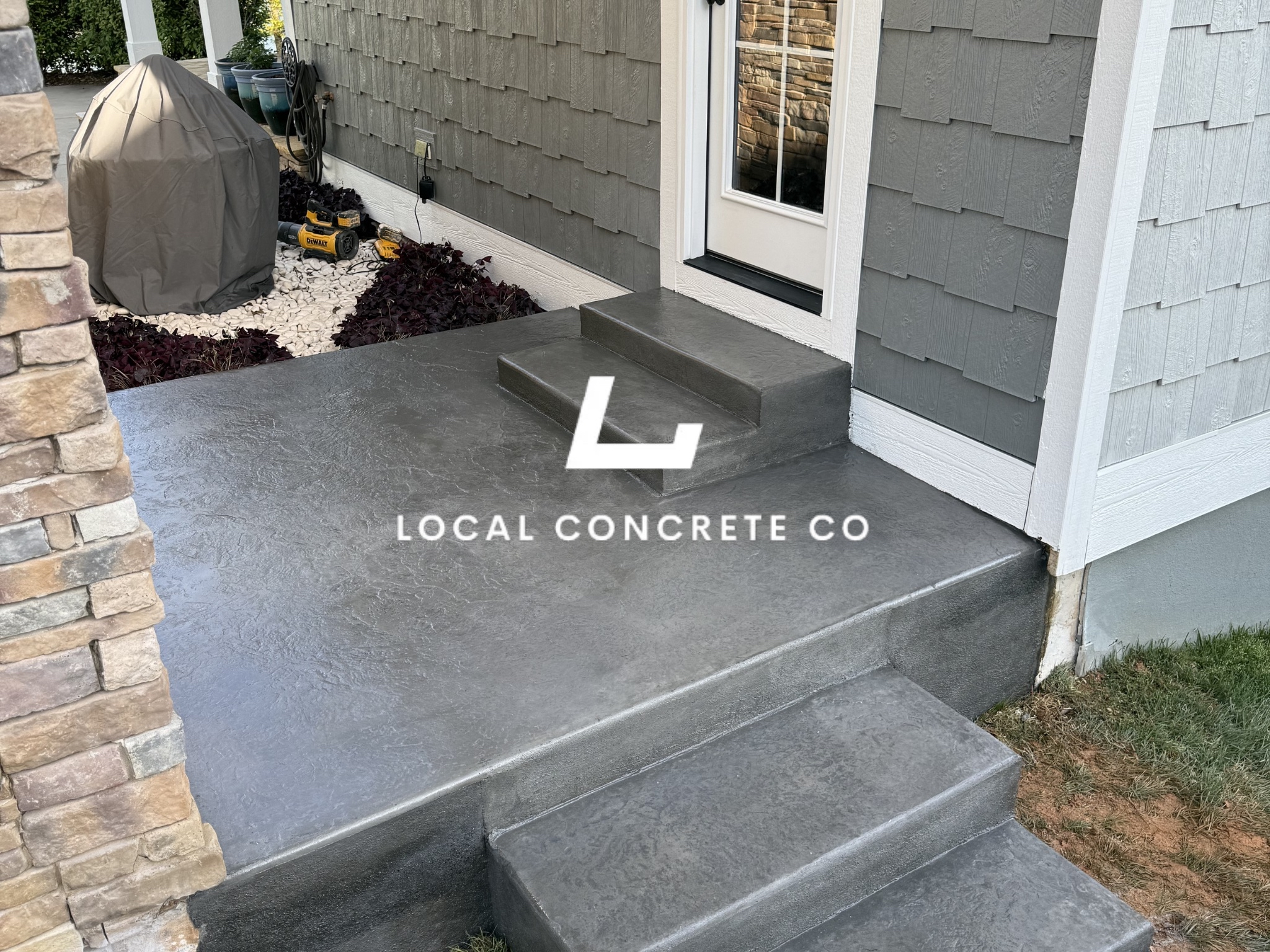
Project Completion
Debris rolls off the truck, your property gets left tidier than we found it, and a written workmanship warranty lands in your email. That sequence — walkthrough signed, site cleared, warranty delivered — is what actually finishes a pour on our books.
Pattern and Color Menu
More than any other decision on a stamped job, the pattern controls how the finished surface reads. Scale is the first lever — a large flagstone that looks correct on a 600 sq ft patio can overwhelm a 4 ft wide walkway. Color layering is the second — a single flat pigment reads plastic under Charlotte sunlight, while a base tone with a contrasting accent release reads like natural stone.
Common patterns on NC residential work:
- Slate ashlar — offset rectangular units, the pattern we set most often across the Charlotte metro for patio and pool surround jobs
- Freeform flagstone — organically shaped stones, the closest visual to real mason-set stone, forgiving on curving edges
- Cobblestone in the Roman layout — compact squares with tighter grout runs, wears well under driveway loads
- Board-plank — elongated slim planks imitating aged lumber, a fit for cleaner modern patio geometry
- Angled brick (herringbone) — the classic 45-degree brick weave, used on porches and walkways
- Straight running-bond brick — parallel courses for a traditional, symmetrical read
Where a stamped slab either sings or embarrasses itself is in the color buildup. The standard NC approach layers three tones: an integral pigment mixed into the truck (earth tones, terra cotta, buff, slate, or a custom color match), a dry-shake color hardener broadcast across the fresh top paste, and an antiquing release agent in a contrasting shade worked in as the mats are pressed. That three-layer stack is what puts depth into the finished slab and lets it read like real stone from the porch or across the yard.
When Stamped Is Right and When It Isn't
Not every residential surface is a good candidate for stamped concrete. Knowing where the finish holds up and where a different treatment makes more sense keeps a homeowner from paying decorative money for a slab whose pattern will be gone in a few seasons.
Where stamped works well:
- Backyard patios, pool surrounds, and outdoor sitting areas that host chairs and moderate foot traffic
- Home driveways when the pour is spec'd at five to six inches with a pattern scaled for tire contact
- Path runs and garden connectors that need to visually match a nearby stamped patio
- Front stoops, covered entries, and porch surfaces that stay protected from constant weather
- Front courtyards and accent side-yard slabs where street-side curb appeal is the goal
Where a different finish makes more sense:
- Warehouse pads, commercial dock aprons, or any surface hosting forklift wheels or tracked machinery
- Rural drive turnarounds where wheel-path abrasion will burn the pattern off the traffic lanes
- Projects where the homeowner won't commit to reapplying sealer on a three to five year interval
- Cost-driven pours where a broom field plus a stamped ribbon captures most of the appeal for a fraction of the budget
We'll walk the surface with you in Ballantyne, Providence, Matthews, or wherever the site is, tell you honestly where stamped fits and where it doesn't, and put the alternatives on paper side by side so the choice is made with real numbers.
Why Homeowners Work With Us
Residential and light commercial concrete across the NC Piedmont — inside 485, out through the suburban ring, and into the surrounding counties — is what Local Concrete Charlotte does. The quoting and invoicing structure exists to hold one line: the homeowner isn't the party carrying the project risk.
What that looks like on a stamped project:
- Nothing owed up front — the invoice comes after the pour is stamped, sealed, and reviewed on-site with you
- On-site walk-and-quote at no cost, with the pattern, color stack, joint diagram, and sealer schedule documented on paper
- Coverage on file — insurance and license paperwork available for your review before we drop the first stake
- No countdown timers, no pushy closes, no quotes that expire if you take a weekend to think
- Photos of stamped jobs we actually poured in nearby Charlotte-area neighborhoods, not catalog shots
- Transparent math on what moves the price — pattern intricacy, color count, slab depth, subgrade shape, area, sealer tier
- The same crew handles you from grading through the final release wash and topcoat — no handing the stamp off to a subcontractor
Still comparing stamped bids? Ask each contractor which patterns they actually own mats for, how many color layers the base bid includes, and what re-seal cadence they recommend. Those three answers are what separate a stamped slab that still reads sharp at year fifteen from one that goes flat and gray inside five.
Stamped Concrete
FAQ
The questions Charlotte-metro homeowners actually ask us about stamped concrete — slab thickness, Piedmont clay prep, cure-time realities, deposit terms, and what the difference is between a pour that lasts a decade and one that cracks the first winter.
Get Free QuoteHow long does stamped concrete last?
Structurally, a correctly installed stamped slab has the same 25 to 40 year life as any well-built concrete pour. The pattern crispness and color read stay sharp for the first eight to twelve years and soften gradually after that if the re-seal rhythm gets ignored. Held to a three-to-five-year re-seal cadence, the visual quality tracks the full structural life of the slab. What actually drives service life is base prep, joint layout, and sealer discipline — the pattern choice is downstream of all three.
How often does stamped concrete need to be resealed?
Can stamped concrete handle NC freeze-thaw?
Is stamped concrete slippery when wet?
Can you match stamped concrete to an existing surface?
Do you require a deposit up front?
Ready to price a Charlotte-metro pour?
Walk-and-bid is free, no deposit at booking, and you only pay after you sign off on the finished slab.
Get Free Quote